Are you facing difficulties in improving your brand’s visibility? You are at the right place to get rid of all confusion. Let’s discuss openly what is happening in search today. As you can see, the world is changing quickly as your customers are looking for good solutions. Clean lists of 10 blue links that are typical of most traditional search engines are no longer the only game in town. Instead, your clients are relying on ChatGPT, Perplexity, Google Overviews and Claude to be able to get straight answers at their fingertips. If you don’t appear in those conversations, then you’re missing out on good-quality traffic that is expanding at a very fast rate.
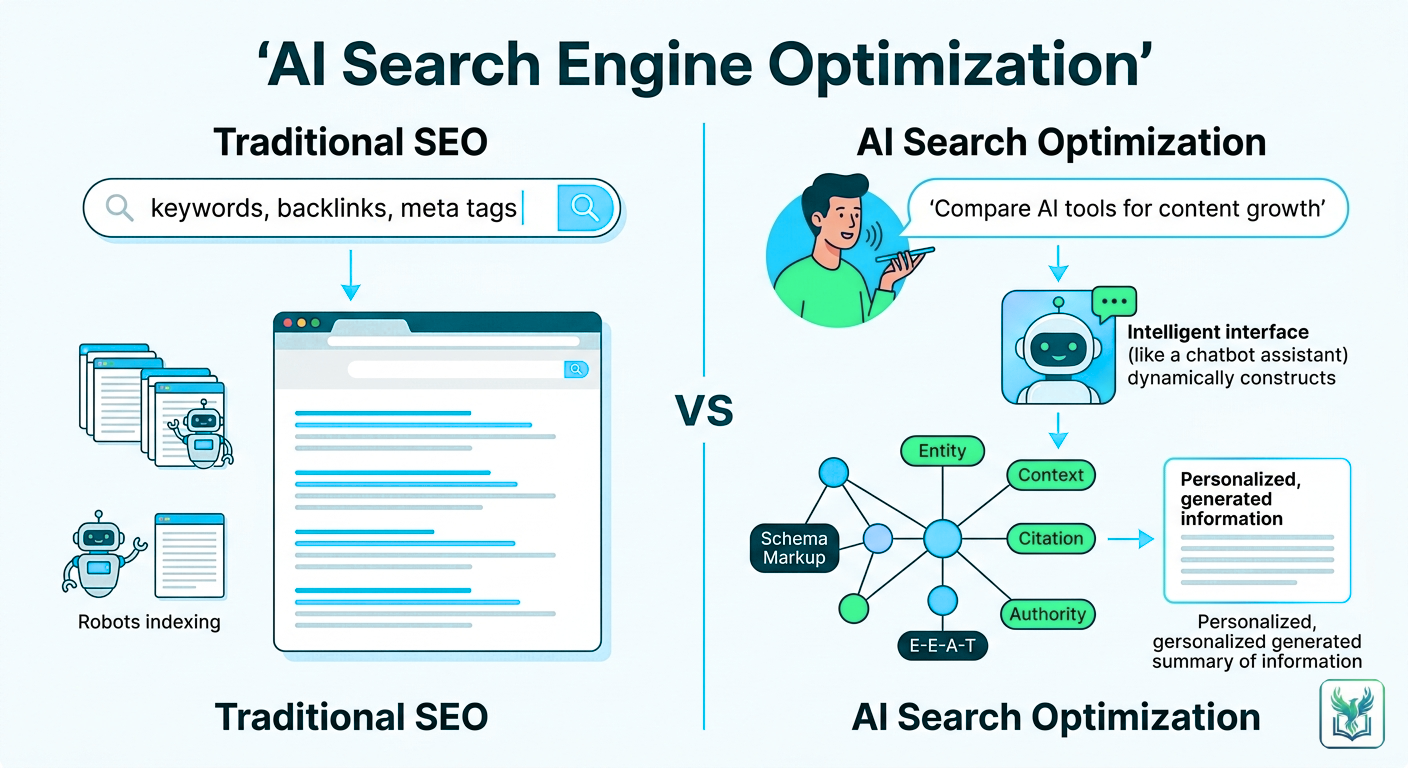
So you may be wondering, how do these systems know which brands to trust? While the methods of traditional SEO still apply to the health of your website, optimizing it for AI means adopting a different approach to the process. Navigating the landscape of AI Search Engines demands a clear and modern approach to achieving brand visibility in AI search engines in order for your business to thrive in this new environment. Studies from David Doty’s Forbes article “AI Is Now Marketing’s Gatekeeper” show that AI models control what buyers know about your brand.
Let’s dive into the specific changes taking place now, why they are failing, and how they can make your business the leading answer for large language models.
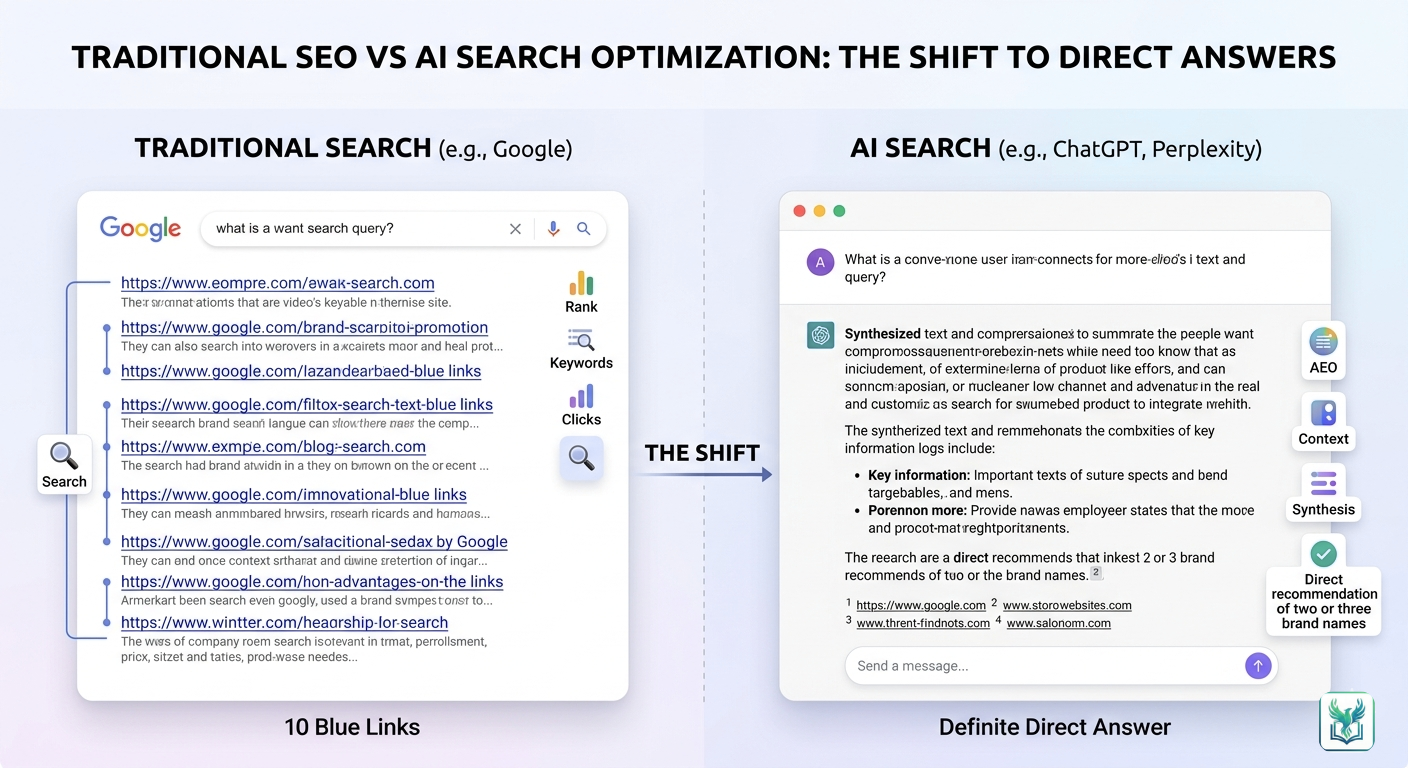
The Big Shift from Blue Links to LLM Direct Answers
Traditional search functions, similar to a library index. A user enters a keyword and the engine delivers a list of books containing the keyword. The user gets everything done, clicks, skims and decides. The application of artificial intelligence is reversed. It reads thousands of resources, summarizes the content, removes the fluff and shows the user one result that has been synthesized from all it has read. According to Google, its fundamental ranking systems and Knowledge Graph capabilities enable AI-generated search experiences to find and combine high-quality information.
Don’t give a customer 10 links when they ask the AI engine for the best software or service in their industry. It will mention 2 or 3 companies and will give a detailed explanation as to why they meet the requirements. Without being in that summary, your business doesn’t exist. You need to work to increase your Brand Visibility in AI Search Engines so that your name is present in all those summaries each time.
Traditional SEO vs. AI Search Engine Optimization
| Optimization Factor | Traditional SEO Playbook | AI Search Engine Playbook |
|---|
| Primary Goal | Rank on page one of search results | Get selected as the definitive direct answer |
|---|
| Target Format | Short keywords and phrases | Full conversational questions and intent |
|---|
| Content Structure | Long-form blogs with keyword patterns | Immediate Q&A layouts (AEO) and data definitions |
|---|
| Technical Core | Meta tags, site speed, and URL paths | Structured Schema markup and Knowledge Graphs |
|---|
| Trust Source | Domain backlinks and anchor text | E-E-A-T signals, digital PR, and web mentions |
|---|
| Success Metric | Click-through rates and keyword positions | AI share of voice and conversational citations |
|---|
Top 10 Strategies to Improve Brand Visibility in AI Search Engines
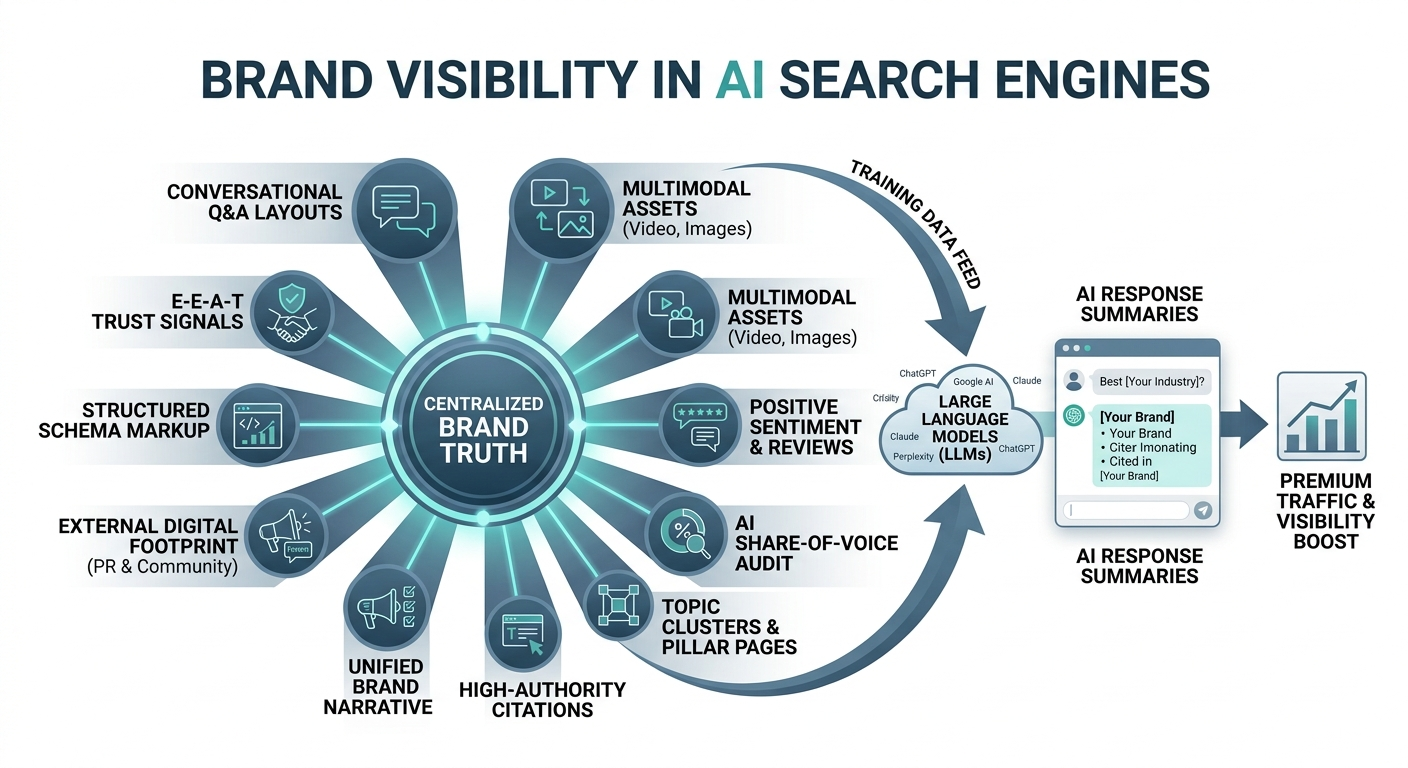
Here is the detailed explanation of the top ten good strategies to get more traffic and visibility:
1. Write for Conversational Intent with Simple Q&A Layouts
AI engines learn the way real people speak. Think about it. We don’t feed a chatbot weird phrases that are broken up. We ask regular questions. Therefore, the content of your website should be in an actual conversation.
This is the way to win Answer Engine Optimization (AEO). Use a direct question directly in your subheadings. Then respond to it immediately in the following sentence. An AI’s mission when it reads your page is to pull that “quick” answer out of the ground. No one would want to read a 500-word introduction to get a simple definition. Provide them with the solution right away. Then, you may discuss the more in-depth information and examples in the remainder of the section.
2. Build Massive Trust with E-E-A-T Frameworks
Large language models come with built-in safety filters. They are afraid to recommend shady, untrustworthy businesses or to make things up. These algorithms prioritize results for the user’s protection by looking at E-E-A-T: Experience, Expertise, Authoritativeness, and Trustworthiness.
We raise your profile here by avoiding the dull, uninteresting text. You should demonstrate your firsthand, real-life experience in your articles. We do not have anyone else’s case studies, unique company data, or original research. If the AI engine finds original data, rather than recycled ideas, it marks you as a great expert in your field.
3. Claim Your Identity with Structured Schema Markup
AI search models are intelligent, but they’re not human. They prefer data layouts that are well-defined and structured. When they have to guess where your business is located, what your product is, or who founded your business, they will likely move on to the next place. Schema markup eliminates all the guesswork.
Imagine Schema markup as a virtual translator specifically designed for AI. You use Organization, Product, LocalBusiness and FAQ schemas to tag your key information. This technical patch goes directly into open-source knowledge graphs. Those graphs are the very foundation of AI search engines for real-world relationship connections. This is an important step in Brand Visibility in AI Search Engines.
4. Dominate Third-Party Platforms and Community Spaces
A fact here is that AI models don’t only observe your website to learn about you. In fact, the majority of their instructional content and citations are from outside, third party spaces. They consumed media articles, forums, industry directories and open-source networks.
If you want to be successful in AI search optimization, you must have a very active online presence. When platforms such as Reddit, Quora, and LinkedIn don’t talk about your brand, your website is like an island in the middle of the ocean, claiming it is the expert.
5. Keep Your Visual and Written Identity Perfectly Unified
AI models are predictive engines. They make estimates of probabilities in order to find the most probable answer to a user’s prompt. When this is not done, the algorithm’s confidence score is lowered and it will no longer include you in the recommendations.
Your brand story needs to be perfectly in sync with all your digital interactions. Your product descriptions, social media bios, executive interviews, and blog posts must use identical core terminology. If you sell “sustainable fleet tracking software,” every profile should call it exactly that. Consistency creates a predictable pattern and predictability is what allows you to secure Brand Visibility in AI Search Engines.
6. Earn High-Authority Citations and Backlinks
For instance, in the Google Overviews or Perplexity answers to a question, they provide small clickable footnote numbers. The footnotes are citations. These are displayed when a user clicks on them and they take them directly to the source website. This is how you’re going to obtain a fresh stream of organic traffic.
In order to receive those citations, you must have assets that are linked. This entails creating special tools, calculators, or deep industry reports that other writers have a need for. When AI search engines cite you, they will cite your site if the links from more authoritative industry sites are pointing to your resource pages.
7. Build Topic Clusters to Prove Deep Industry Authority
Randomly publishing articles on your website is now a bad idea. The AI engines search for systemic topical depth. They want to know you know your industry inside and out, be it from the basics or deep and advanced workflows.
We do this through creating content clusters. Also, we produce one high-level pillar page for your main service, while adding ten highly focused sub-articles that focus on specific aspects. We then link them all with clean and logical internal links. This network structure will let people know that your site is an extensive knowledge hub, greatly improving your Brand Visibility in AI Search Engines.
8. Constantly Audit and Test Your AI Share of Voice
What you can’t measure you can’t manage. In this not-so-typical place, conventional rank tracking methods won’t provide you with the whole story. It’s essential to proactively review your brand as it is represented by big language models in real time.
We do that by asking various AI engines different natural language sentences that are used daily by your customers. Also, we invite them to benchmark products in your area, name the best service providers or address an industry issue. We then look at the results: Was your brand found? Is the information correct? Where are they getting their information from other than you? These engines can be used as active test environments, which means that we will be able to continue to optimize our content and fill more space.
9. Focus on Natural User Reviews and Sentiment
Brand sentiment is a critical factor for AI algorithms. They are not only looking for mentions of your brand, but they’re also paying attention to your brand’s tone. If you have unanswered public grievances or have signs of poor ratings, AI tools will deliberately exclude you from their profile since this would upset their clientele.
We need to have an active review acquisition system. There is a need to systematically gather positive feedback from the big tech review sites, local business directories and industry-specific aggregators. AI engines are able to extract important positive phrases, user praise, and success metrics from these text blocks. Thousands of humans are actually validating your service quality, reassuring the AI that you are a safe recommendation, thus reinforcing your Brand Visibility in AI Search Engines. Impact.com’s 2025 Global State of Affiliate Marketing report revealed that almost every brand (97%), creator (96%), and publisher (87%) has used AI in their work to get benefits.
10. Maximize Digital Footprint Breadth Across Diverse Formats
The dominance of text is gone in generative answers. AI search engines of today are multimodal, taking in text, images, video transcription, and audio transcription at the same time. If you have a content library of only text paragraphs, you’re missing out on half of what crawling can do for you.
Primary research data will be converted to easily downloadable infographics, case studies will be condensed and narrated in short video walkthroughs, and tutorials will be shortened and transcribed into a structured audio transcript. Your optimized multimedia elements will be just the right fit when you need to include an image or video with your AI response. This wide media format will ensure your Brand Visibility in AI Search Engines.
Summary
Generative search is not something that’s going to happen in the future; it’s happening right now. It takes a combination of good technical markup, conversational writing and lots and lots of off-site authority building to optimize for these new platforms.
With these cutting-edge tactics in place, your business is not going to become digitally invisible. We will make your brand the go-to and trusted solution that AI platforms can confidently suggest to their future customers. Begin your all-around Brand Visibility in AI Search Engines today and dominate your market tomorrow.
Frequently Asked Questions
1. What are the differences between traditional search optimization and AI search optimization?
The traditional SEO approach focuses on keyword optimization, and the results are presented as a list of blue links. AI search optimization is about organizing conversational data in a way that the LLM can easily comprehend and suggest your brand in the summary.
2. How do AI search engines discover information about a brand?
AI search engines find information by crawling your website data, reading structured backend schema markup, and parsing third-party networks. They focus a lot on discussion across news sites, community forums and trusted industry directories.
3. What are the advantages of using citations in generative search summaries?
Citations are shown in small footnote links within the generative search summaries of text. AI platforms choose these authoritative links based on the accuracy of the information, the trustworthiness of the source website, and the strength of the backlinks.
4. Can public reviews impact how an AI engine views a business?
Yes, public reviews have a direct effect on visibility as AI algorithms actively look at text blocks for brand sentiment. If the model receives positive reviews from multiple independent directories, it will be more inclined to recommend your business.
5. How often should a business audit its visibility in AI tools?
To check the visibility of a business, it should conduct an audit once a month by testing direct conversational prompts on key AI tools. Monitoring brand mentions and citations can help you keep your content up to date with model updates.
Sources:
https://www.linkedin.com/pulse/what-strategies-improve-brand-visibility-ai-search-engines-soci-ai-tx3wc/
https://www.copy.ai/blog/brand-visibility-in-ai-search
https://commitagency.com/insights/what-strategies-improve-challenger-brand-visibility-in-ai-search-engines/
https://impact.com/affiliate/improve-brand-visibility-ai-search/
https://roirevolution.com/blog/ai-search-optimization-and-brand-authority/
https://fritz.ai/ai-strategic-visibility/