
Edited by
M. Ibrahim

Reviewd by
Abdul Qadir

Edited by
M. Ibrahim
Reviewd by
Abdul Qadir

Avoid side hustle scams by refusing to pay fees before work, ignoring high pay offers for not-so-hard work, and independently verifying companies before sharing your personal details with them.
A side hustle scams is a fake job or gig designed to trick you into giving them your money, your personal information, or both, typically with a promise of easy pay for almost no effort. These scams have grown with the rise of work-from-home scams, and they appear in all corners, whether it’s via text message, social media DM, job board, or even in an email inbox you never registered with.
Scammers constantly test their pitches to see which ones get the greatest response, which ones don’t pass spam filters, etc. Their goal is to get your money, your information, or both, as swiftly and as discreetly as possible.
In this guide, the side hustle scam warning signs are explained individually so you can spot a real opportunity if it’s one or a trap if it’s not.
An online side hustle scam is something that is designed to pull something from you, either in the form of money, a wire transfer, your Social Security number, or even your time in the scam, which you did not even realize that you had fallen into. Urgency and flattery are fraudsters’ weapons to bypass your decision-making process. The first line of defense against almost all forms of this con is to take it slow.
Here are the 12 red flags to observe while making any decision:
Almost no skill makes hundreds of dollars a day? Don’t see that as a blessing but as a warning. Real income is directly related to effort, experience, or risk. When the numbers don’t add up, it’s probably not the real one.
Scammers know that a big number will get the attention of a reader more quickly than a small number, which is why they go big first and then leave the job description very general.
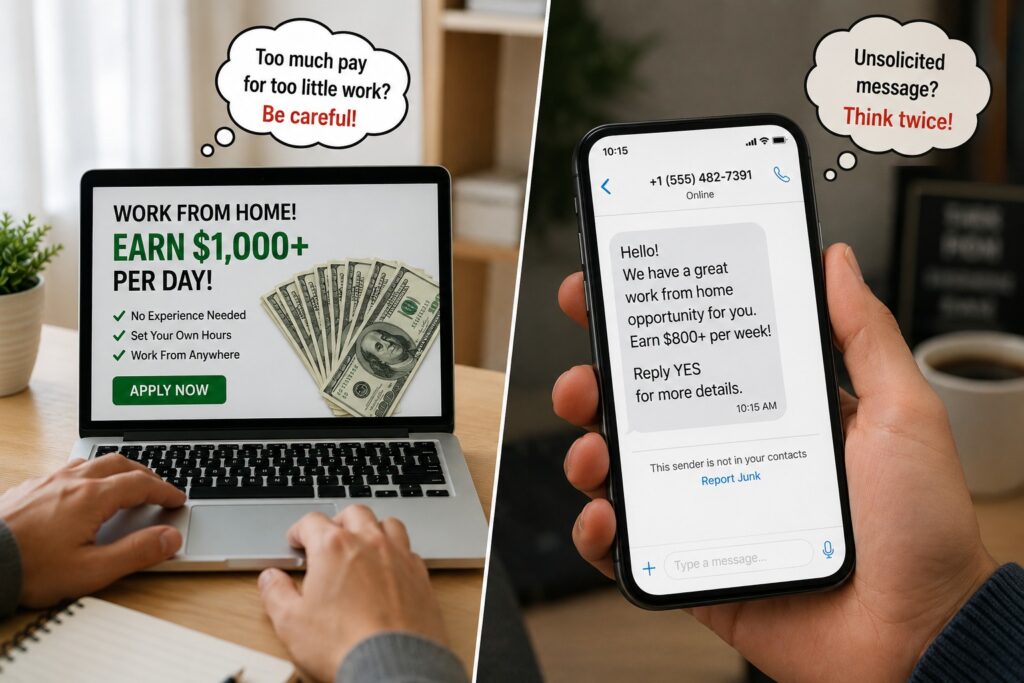
Any good company that offers to pay a stranger thousands of dollars per week will not do it by text message. Don’t be fooled by a message you get in your inbox, DMs, or phone with an offer that you didn’t even apply for, particularly one that never had any part of the application process that involved you.
This is not a typical way to begin a recruiting process. Most companies find their employees through applications or referrals or from platforms that you’ve used before, rather than a cold message from a number you don’t know.
One thing is for sure, and it’s one of the biggest indications of scam side hustles. No real business asks for “onboarding fees” or access to software or training kits until it pays them a dime. The money is flowing in your direction. If it’s flowing away from you first, walk away. This one rule will attract a lot of side hustle red flags before they continue.
Search for the company’s name on Google. Use Google to find their name. No hits or just the job ad itself? That’s a problem. A good company would typically have a web page, employee feedback, and some sort of history that you might be able to check out.
The simplest method to recognize that you’re being scammed is when you don’t obtain anything in your search results, and checking is not as time-consuming as reading this section.
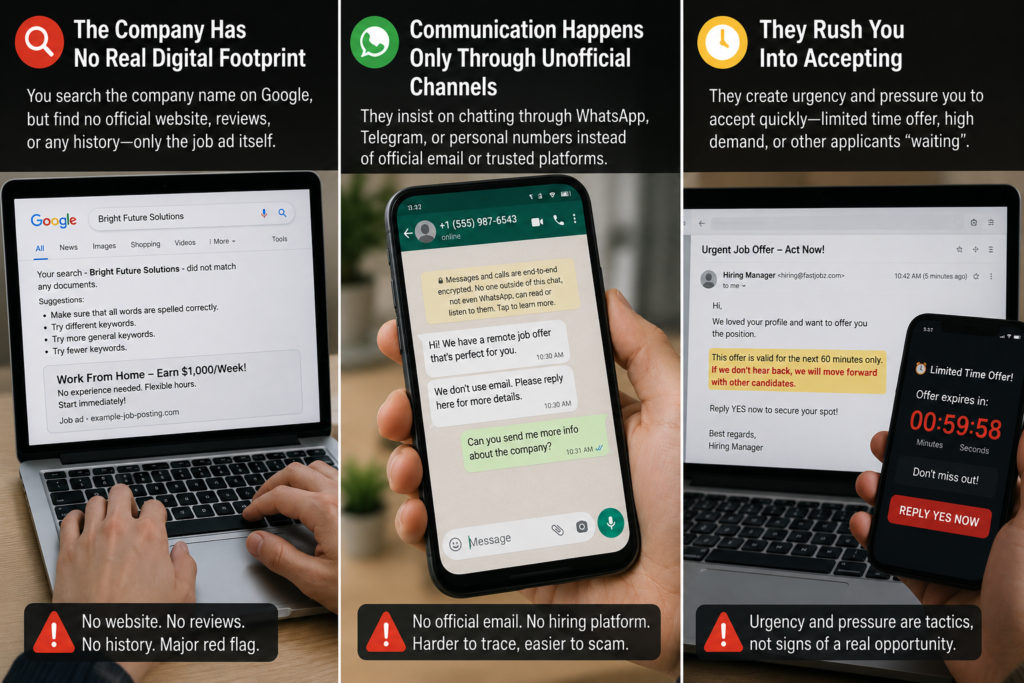
Avoid recruiters who require you to communicate with them through WhatsApp, Telegram, or a private cell phone as opposed to a company email or a trusted hiring platform. Avoid this type of channel, since it is more difficult to track and harder to get rid of after they’ve done their work. Don’t be afraid to avoid a paper trail with a real employer.
Pressure is not just something that happens; it’s a tool! If it’s been mentioned that it will be only an hour till the offer goes away? Do you have other applicants who are bidding for your position? The sense of urgency is created. When you think about it, there’s a really good opportunity there. If that’s not something he can do, he’s not a recruiter who provides jobs.
Maintaining flexible income flow, working from anywhere, earning from anywhere. The reason for the phrase “sounds good” is that they have nothing to say. Don’t know what a day at the office entails? Likely, there isn’t any real position behind the pitch. What is a typical “Tuesday” like at work? Note the level of detail in the response.
The employer’s first request is NOT your Social Security number, bank routing information, or a copy of your ID. This information is not provided in the exchange of the first messages, nor before an offer is made, but it is requested.
What they all have in common is that they are very difficult to recover. The side hustler wants you to purchase their product; they give you a gift card or crypto, and it’s not quirky; it’s for them to be paid. It is a plan that is centered on one thing: once the money is given, it’s out; there is no bank transaction to protect your money. This is one of the common side hustle scams to be aware of.
You receive a check for more than it’s worth; they ask you to send them the extra amount or to deposit it somewhere else. A few days later, the check bounced. The bank’s job is to ensure that all funds that have already been withdrawn from your account are withdrawn. The scam is still in use and has been in circulation for years because the funds seem to be removed prior to being discovered by the victim of the scam.
“It was the best thing that ever happened to me.” Giving up my 9-to-5 job and never returning. Scam listings tend to sound very generic in their reviews, such as this. If all of the reviews look the same, or you haven’t seen a review outside of the company’s review page, hear them and take it as a sign. A real business will eventually build up a lot of reviews, some of which will be positive and some negative. Not a blanket praise, “one size fits all.
If you are making money on the back of new customers but not from any actual labor, then you’ve stumbled upon a pyramid scheme in the clothes of a side hustle. The real value of real gig work is created by the worker. Schemes pay for growth until growth stops, and when growth stops, the payouts stop, and everyone below the top of the chain gets nothing.
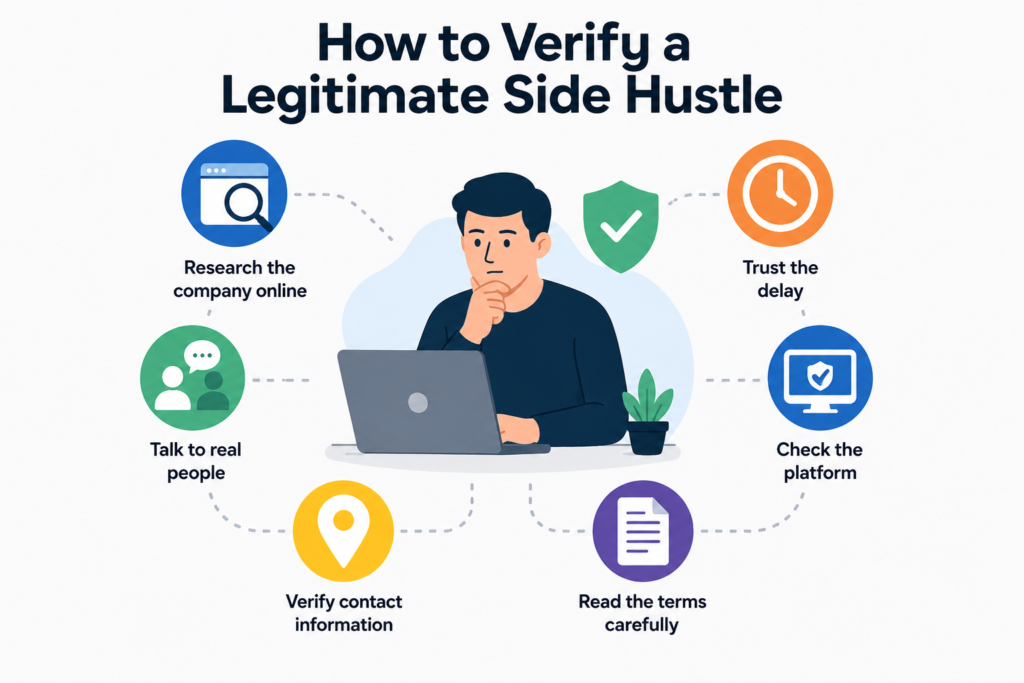
Did you notice any of these red flags of a fake job online? Most scams are easily exposed upon a modicum of investigation. They are not meant to be answered slowly; they are meant to be answered quickly. Here are the following ways to verify a legitimate side hustle:
If you are looking for a legitimate method to earn money online, the Best Side Hustle for College Students is freelancing, as it allows you to gain real skills, earn a good income, and avoid many of the scams I have discussed above.
If you gave money or account details, inform your bank immediately and ask them to cancel or reverse the payment. If your Social Security number is stolen, consider a credit freeze on your accounts to make it more difficult for new accounts to be opened in your name. Change passwords and user names on other accounts as well if you have used the same on those accounts, since scammers typically use the same credentials on other accounts.
Be not embarrassed to report it to the Federal Trade Commission (FTC) at ReportFraud.ftc.gov. It’s the scammer’s job to be very good at this. It isn’t carelessness if one falls for one. It’s indicative of the effectiveness of these schemes, and it’s good to report it so that the next person who falls for the same pitch can be alerted to the pattern.
Important Note: According to the U.S. Federal Trade Commission (FTC), it received 2.8 million fraud reports in 2021 that included many related to job and employment scams. This high statistic shows how common fraud job offers have become and makes it important to verify any side hustle opportunity before sharing personal information.
Identify a fake side hustle by searching for the company’s name and adding the word ‘scam’ or ‘complaint’ to the search query. When there is no response or if a payment is requested up front, this is likely to be a yes.
Seek a genuine hiring process, a verifiable business address, and a stream of cash going to you, not away from you.
Identify any invoices that are not solicited or have unusually high costs, ambiguous descriptions of services, pressure for immediate payment, or vendor accounts that are unknown.
Do not pay to obtain employment! There should be a job that pays you. If you need training, then they should pay for it or give it to you, but you don’t give money to a person who offers you a job.
Fake online jobs examples are when you involuntarily send forward goods that you bought with a stolen card. They’re among the most popular fake side hustle jobs that are currently running around.
The most significant red flag is the requirement to pay any money up front in order to make a beginning at something. Legitimate online jobs and freelance jobs pay you for your work. They don’t charge up-front registration, training, software, or “activation” fees for you to get work. Scammers use promises of big payouts with minimal effort to entice individuals to pay these fees.
Additional alerts are:
Before entering into any online earning opportunity, you should research the company, read independent reviews on the company, and avoid any opportunity that requires an upfront payment to begin work.
They are successful because they speak the same language as legitimate opportunities, flexible work hours, fast cash, and no experience. The best way to avoid work-from-home scams is to look at the details, the upfront payment request, the unsolicited message, and the pressure to make a decision now. Always check before transacting.
If you see something that you cannot possibly see why someone would want to do this, that’s what they will do. If an offer, you can’t believe that someone would pull this one, then that’s what it’ll be. There is still other money to be gained, and there is true work to be done on the side. It won’t come from a person who will force you to make a rash decision.