
Edited by
M. Ibrahim

Reviewd by
Abdul Qadir

Edited by
M. Ibrahim
Reviewd by
Abdul Qadir
Creating a convincing freelancing portfolio means you should choose only your best projects, describe the outcome you delivered and showcase your work in a readily accessible way.
Starting freelance work feels difficult when you have skills but nothing to show potential clients. I have seen how much easier it becomes to present yourself professionally once your work is organized into a clear portfolio. For more freelancing tips and resources, visit Incomrise.
A freelance portfolio is a good indication of what you can do for clients. You do not have to build up to years of experience, dozens of projects, or a long client list to build one up. You will need a few samples that are relevant to and easy to understand your skills.
When it comes to how to build a freelance portfolio, you should begin by selecting one service, making three to five samples that you can offer and present effectively. When a client hasn’t worked with you before, your portfolio is proof of your ability.
A freelance portfolio is a set of work samples that showcase your skills, services and method. It provides potential clients with something tangible to look at prior to contacting or hiring you.
A content writer, for instance, is able to demonstrate their blog posts, product descriptions and website copy. A graphic designer can display logos, social media graphics and packaging designs. A web developer can present websites, screenshots or links to projects.
There’s no need to submit your entire portfolio. If you get too much ‘unrelated work,’ you are making your service less clear. Consider it your best efforts.
Clients tend to ask to view examples before they will trust someone with a client’s project. A portfolio minimises the risk of guesswork as the client is able to assess your work quality, style and relevance.
The portfolio samples are not required to come from clients on Upwork, Upwork says. Sample projects can be made just to showcase the skills and previous projects or work that is used in other work can be used.
A portfolio also helps you to position yourself. Five examples, no matter how well they do the small business message, will not send the message as strongly as three SEO blog posts. Don’t try to prove your ability to do everything. You will know what you can offer your client who reads your portfolio.
Pick one of the best freelance skills to learn and focus on the service you want clients to hire you for. Begin with your service.
Pick the service you want clients to hire you for.
Examples include:
There are a few similar services that can be offered following. A focused portfolio at the outset helps to make your offer more comprehensible. The guidelines page on Upwork’s current website also encourages showcasing your niche and skills, rather than your entire work.
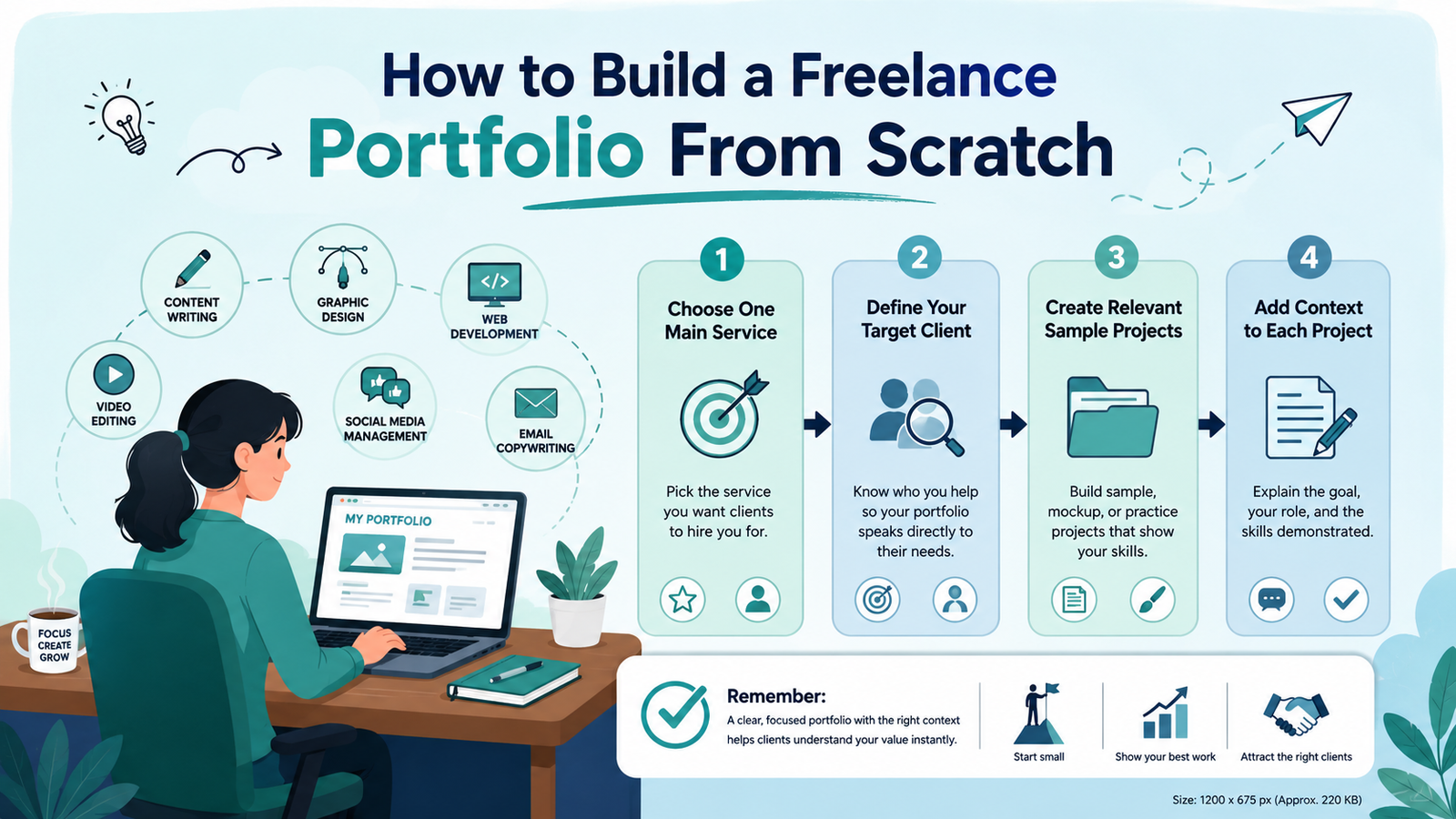
Then you have to figure out the person for whom you are creating the portfolio. Another writer might care to connect with Saas businesses. A graphic designer could specialize in local business and restaurants. One of the potential fields for a virtual assistant could be coaches or online stores.
This option will affect the samples you will be creating. A sample article on 10 easy dinner ideas isn’t as helpful when it comes to writing for health websites, as an article showing research, clear health explanations and SEO structure around a health topic.
Enjoy your first customer without waiting. Make realistic projects according to the type of job you want. Indicate their type as sample, mockup, practice or personal projects. Do not pretend to be doing some kind of paid assignment when it is not.
Content for a beginner writer:
A graphic designer can create:
A web developer can create a prototype website for an imaginary company, which features photos and a real link.
Do not upload a file without providing the client with the necessary information. Describe the purpose of the project, the activities you performed and the skills you acquired.
For example:
Project: SEO Blog Article
Goal: Explain a complicated topic in simple language and target informational search intent.
My role: Research, outline, writing, on-page SEO, editing.
Skills shown: SEO writing, research, readability, content structure.
This gives the reader a reason to look at the sample instead of simply asking them to judge a random file.
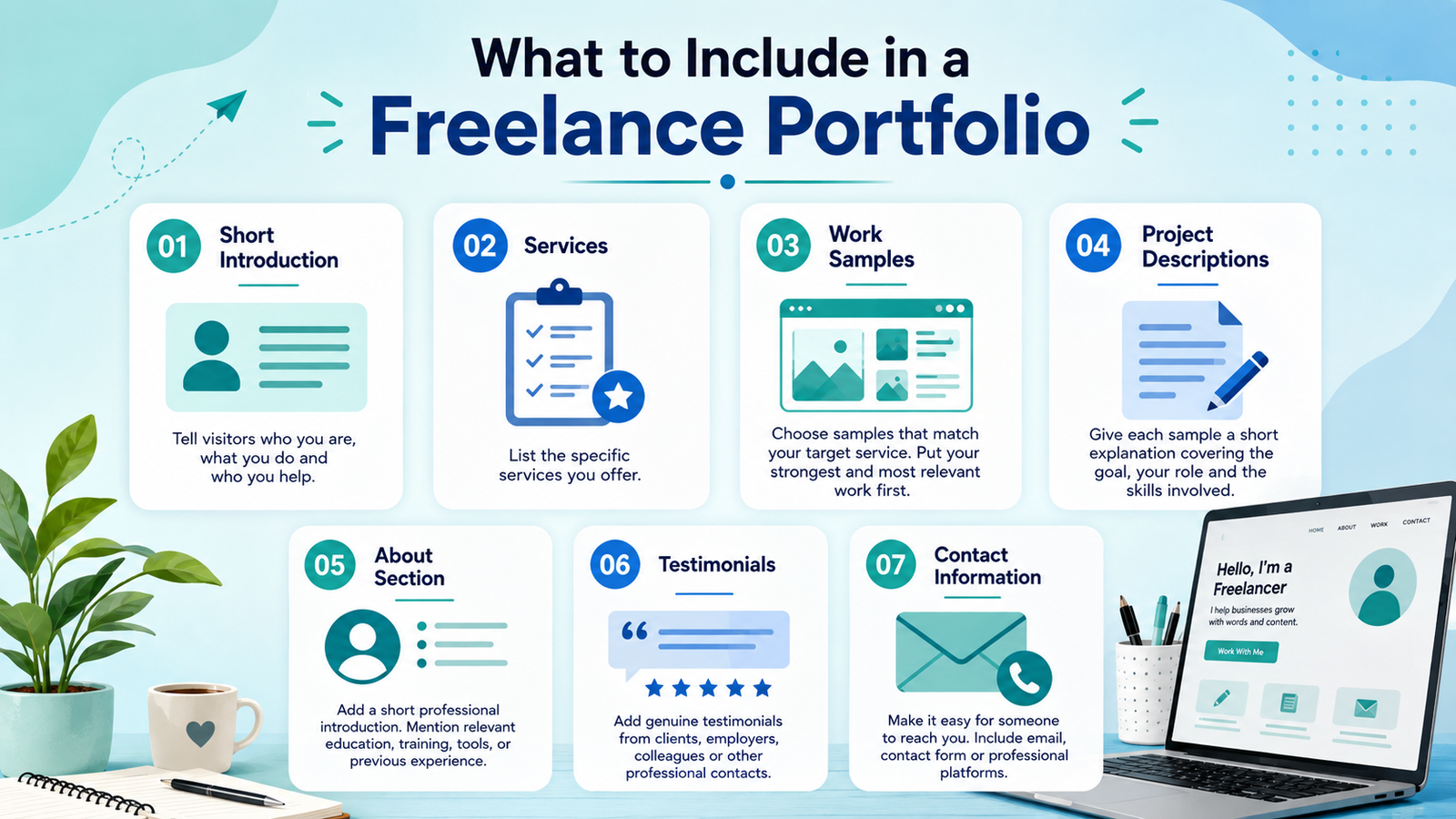
Knowing what to include in a freelance portfolio makes the creation process much easier. A simple portfolio can contain these sections:
Tell visitors who you are, what you do and who you help.
For example:
“I’m a freelance content writer who creates SEO blog posts and website content for small businesses and online brands.”
That’s enough. You don’t need a long personal story.
List the specific services you offer. A writer might list SEO blog writing, website copy, product descriptions and email copy.
Choose samples that match your target service. Put your strongest and most relevant work first.
Give each sample a short explanation covering the goal, your role and the skills involved.
Include a brief introduction at the beginning of your letter. Speak about previous experiences, tools, education and training that relate to your service.
Include real quotes if possible. Get permission from former clients, employers, colleagues, or other valid professional contacts to publish their comments. Please do not include bogus reviews to boost an “old” portfolio.
Be easy to get in touch with. Provide an email address (or other contact form) and a business form to receive queries.
A beginning freelance portfolio doesn’t have to conceal the fact that you are a new artist. Rather, accentuate the product that you can create. If applicable to your service, begin with projects from school, university, personal projects, volunteer work, your last job or self-directed practice.
You can also create new samples specifically for your portfolio.
Suppose that you are a virtual assistant and you don’t have any clients at all. Design and make a fictional online business process. Make a mock Google Sheets tracker or an example of a weekly task dashboard, organize a fake content calendar, or develop an email-management system.
A web developer can build a demo landing page. A writer can create three articles around one niche. A designer can develop a complete visual identity for a fictional company. This is one of the most useful ways to build a freelance portfolio with no clients. If content writing is the service you want to offer, learning how to make money as a freelance writer can also help you understand what clients look for.
Twenty or 30 projects are not necessary to look professional. If you are a beginner, 3-5 good projects will suffice to begin with. It will depend on your service and the range of diversity that your clients require to see. Three detailed writing samples may be more impactful than 15 short articles that don’t resonate with the services you’re marketing.
New graphic designers on Fiverr are also advised to start with at least two samples and the importance of quality over quantity is also highlighted.
A useful rule is:
Start with 3–5 strong samples. Add more only when they show a skill, service, industry, or style that isn’t already represented.
You don’t need an expensive website when you’re starting.
Your options include:
A freelance portfolio website provides you with more control over the presentation and brand you’re putting out there. Services, projects, information about and contact can be provided on separate pages. Don’t spend weeks designing a website before actually building the site.
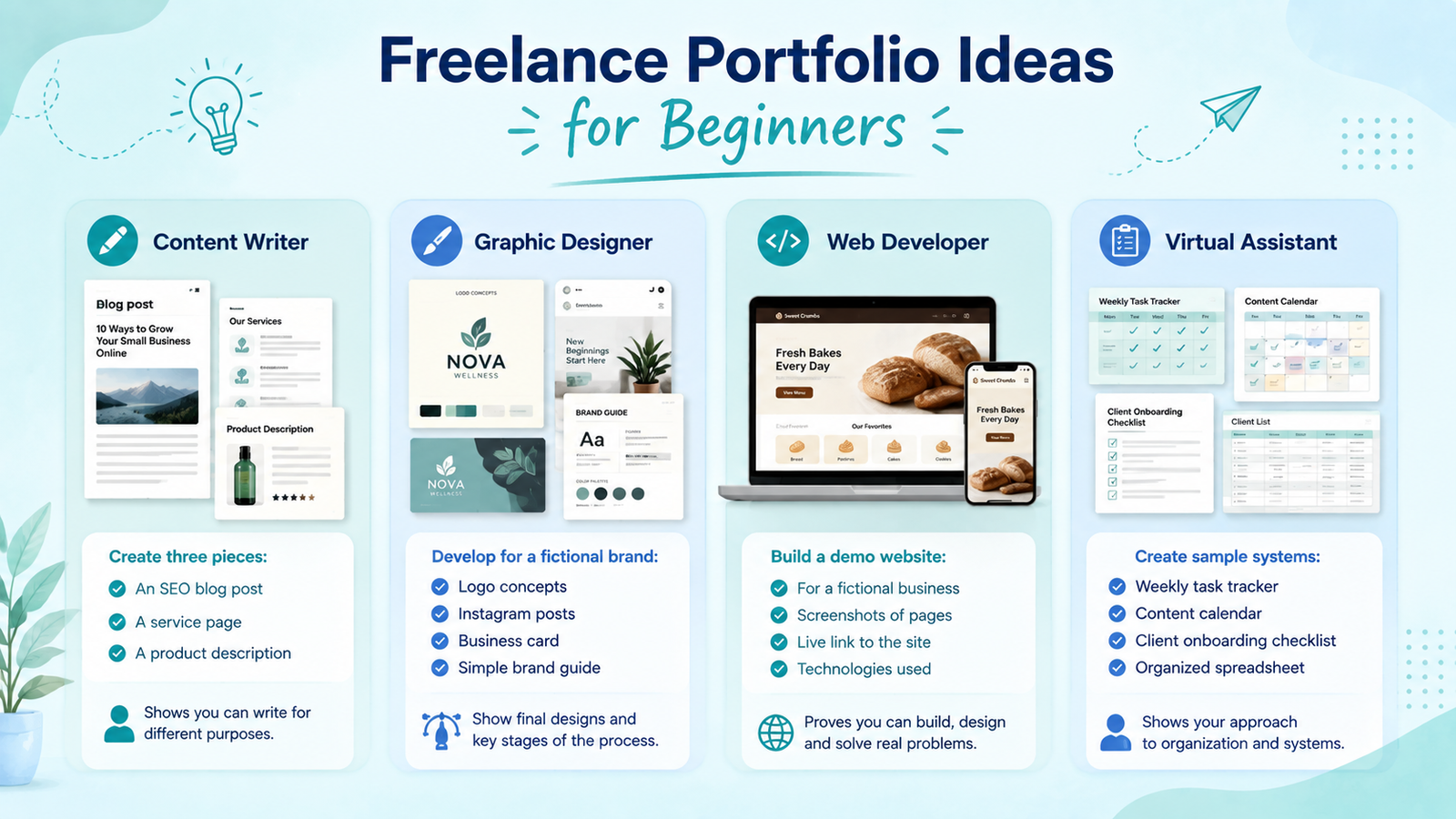
If you’re staring at a blank page and don’t know what to create, use a real business problem as your starting point.
Choose a real or fictional business and create three pieces for it:
This demonstrates that you can write for different purposes.
Create a fictional brand and develop:
Show the finished designs and, when useful, a few stages of the design process.
Create a demo website for a made-up company or service like a bakery, gym, tutoring company or local shop. Provide screenshots and a link to the live site that the technologies are used in.
Create sample systems such as:
These examples show how you approach organization rather than simply saying you’re organized.
There’s no need to wait for your first big client to learn how to create a freelance portfolio. Build upon the service you wish to sell and develop 3-5 strong samples, clarify what each of your projects proves and arrange all the work so that a potential client will be able to see your skills in a quick and easy manner.
Your initial portfolio won’t be super perfect. That’s fine. Keep it updated as you acquire actual projects, models and authentic feedback. The next step is easy: decide on one service now, make your first sample and then make the other services that you want to bring in to fit around this particular type of freelancing work.
Yes. Make real-life or mock-up projects with true labels of personal or practice work. Make sure to sell the specific service you wish to sell.
Clients often rely on a portfolio to determine your quality before hiring you for many services that are offered by freelance professionals. The format may vary, but useful proof of skill is relevant work samples.
Yes, if they are relevant and you are allowed to share it. Explain what you personally contributed and don’t imply that it was paid client work.
Not necessarily. Consistency can be achieved using related projects. Each sample, however, should contribute a valuable addition, whether in the form of a new service, a new format, a new industry, or a new skill.
Yes. If you can, a simple initial version can be developed quickly if you are familiar with your service. Select 3 good samples, brief descriptions, contact info and publish it on a simple platform. Practice it as you gain experience.