
Edited by
M. Ibrahim

Reviewd by
Abdul Qadir

Edited by
M. Ibrahim
Reviewd by
Abdul Qadir
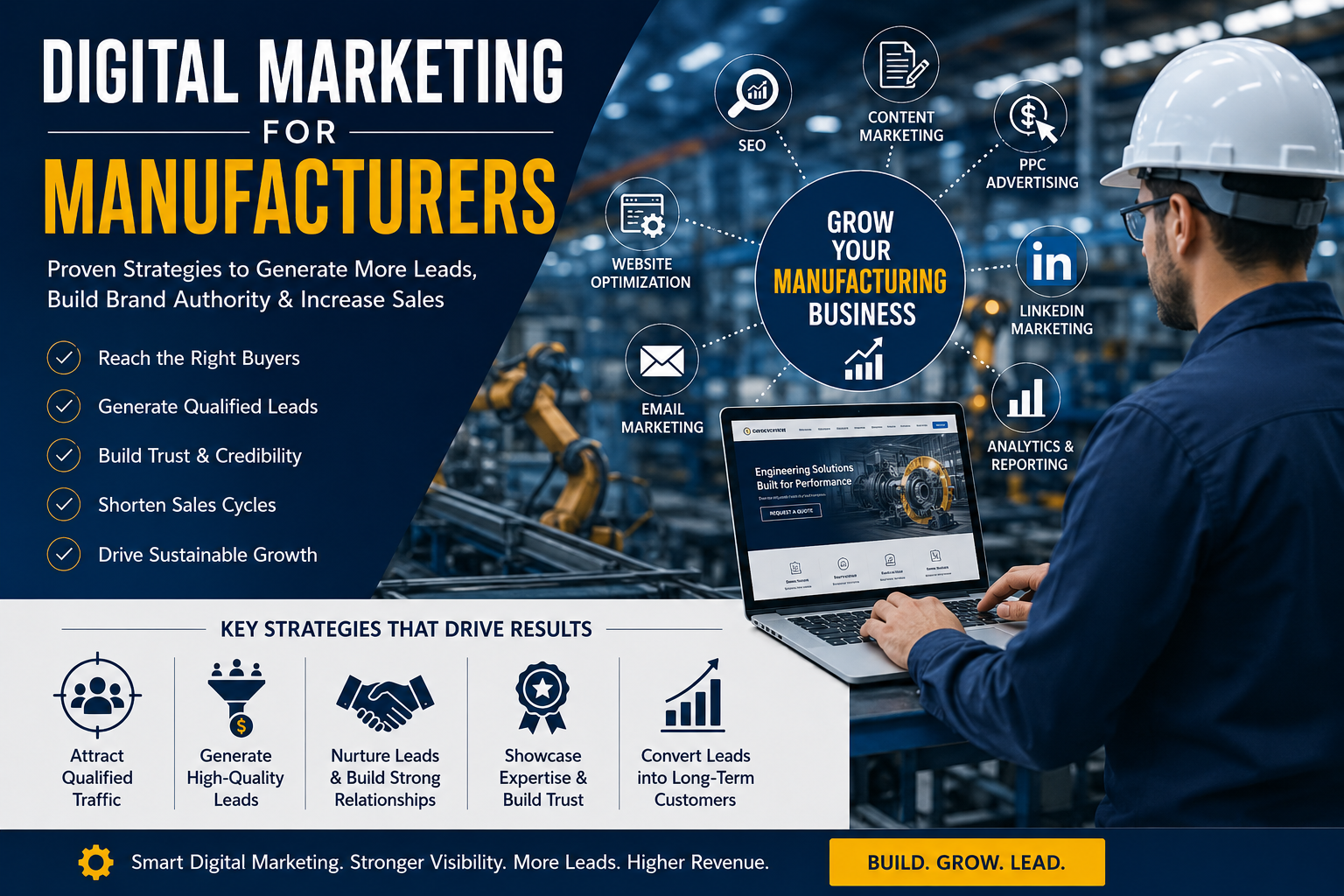
Do industrial buyers go online and research a supplier before calling them? A Forrester study reveals that 74% of B2B buyers do more than half of their research online prior to a purchase.
Growth in the old ways of doing business, including traditional trade shows, cold calls and legacy distributor networks, no longer exists. Today, procurement teams, plant managers and design engineers are looking to search engines for background information on suppliers and for custom capabilities.
This is a detailed explanation of how to create a system for digital marketing for manufacturers that brings in consistent pipeline value.
💡 Read Also: Learn the [10 powerful strategies to improve brand visibility in AI search engines] and stay ahead of your competitors.
A specialized digital marketing agency for manufacturers matches technical specs found in the industrial world with web visibility. How is it that generalist marketing agencies often fail in this industry? Don’t know the procurement process in industry, compliance issues or the engineer’s speak.
Precision, tolerances, production capacity and international certifications (such as ISO or AS9100) are the key features that industrial buyers seek. A dedicated digital marketing for manufacturing companies can transform a complicated engineering catalog or custom manufacturing ability right into an on-line lead generation system. They connect tech-savvy and digital search intent.
Search Engine Optimization (SEO) is the solution that directly links you to high-intent industrial buyers when they need it. Industrial buyers don’t tend to look for such terms as “blue” or “industrial.” Instead, they enter into search engines part numbers, material compositions and industry standards.
Pay-Per-Click (PPC) advertising with Google Ads will give you instant visibility on search engines, while organic SEO will help to create momentum. But, bidding on broad-match terms can become a very costly business for industrial marketing without generating qualified Requests for Quotes (RFQs).
| Strategy Layer | Common Pitfall | High-Performance Solution |
|---|---|---|
| Keyword Target | Bidding on broad terms like “metal stamping.” | Target precise transactional phrases like “automotive progressive die metal stamping.” |
| Brand Protection | Allowing distributors to hijack your brand name searches. | Run targeted branded search campaigns to dominate top search results. |
| Audience Filters | Displaying ads to hobbyists or retail consumers. | Apply strict negative keyword filters such as “DIY,” “repair,” “jobs,” and “retail.” |
📌 Related Content: Discover the best ways to scale your marketing with AI accelerate your business growth today.
To use paid search effectively in the context of digital marketing for manufacturers, you need to align your ads with the different stages of the buying cycle. For example, at the top of the funnel, a whitepaper may be given and at the bottom of the funnel, a user might be directed to an RFQ form. To ensure ads are not wasted, it’s sometimes best to work with a reputable digital marketing agency for manufacturing companies to guarantee your efforts are successful.
The typical length of the industrial sales cycle is long, more than 6 months and sometimes more than a year. These cycles involve a number of decision makers in purchasing, engineering and operations. These different personas are educated at the same time with the help of content marketing.
“According to data from Gartner, an average B2B buying group consists of 6 to 10 decision makers who have their own four to five pieces of information that are not shared with the others.”
These groups are looking to convert, so don’t rely on general corporate messaging, but instead take the time to invest in high-value technical content assets.
Is there any possibility of digital marketing in manufacturing being effective on social networks? Yes, provided that you’re looking at the correct platform. 8 out of 10 B2B social media leads come from LinkedIn. Unlike a viral consumer meme, Industrial brands don’t need viral thought leadership; they need to gain the trust of their target customers through authoritative thought leadership.
Don’t send the same “mass” e-newsletter to everyone on your database each month. Use industry sector, application requirements and job roles to segment your email lists so they are relevant.
A procurement manager is seeking information about how to ensure the stability of his supply chain, how he can get a good discount and lead times that are guaranteed. On the other hand, a design engineer desires to see data on materials science, tolerance and prototyping capabilities.
The manufacturer’s Web page is their Digital Storefront and Sales enablement method. The user interface is confusing; documentation is not there; pages take too long to load, all can create friction that pushes buyers to other companies.
It’s challenging to develop everything in-house. It takes the skills of an SEO expert, paid ads expert, content expert, web expert, email automation expert, an analytics expert and a lot of hats for one in-house team.
The combination of an internal expert with deep expertise in the products and customers, combined with an outside expert, a specialist digital marketing agency for manufacturing companies, is the most successful approach many manufacturers can find. The agency adds talent for technical marketing. The expertise and the context of the product come from the internal team.
If you’re searching for a digital marketing agency for manufacturing, as opposed to a generalist agency that may have some manufacturing clients, then look for one that knows about B2B buyer journeys. Specialization is important, that makes a difference.
There are some points we’ll highlight as we are constantly seeing these:
Lack of an actual plan. Having a few posts on LinkedIn from time to time or running one Google Ads campaign doesn’t constitute a strategy. It’s an activity that is not guided.
Producing content that no one will discover. Great blog posts that do not have SEO optimization are NOT seen. But if the right people cannot discover technical content, it’s worthless.
Ignoring mobile. There are lots of your customers who are engineers, looking at the specs on their phone or tablet. This is because if your site is not mobile-friendly, then you are losing them.
No lead nurturing. The first step is to get a Lead. With a 6-12 month sales cycle, there needs to be a follow-up system to stay relevant. If there’s no cold lead, warm leads are lost.
Measuring the incorrect things. Traffic is vanity. The only thing that counts is leads and revenue. Monitor the business’s progress towards what’s really working.
Organic SEO usually brings in results that are significant after 4-9 months. Industrial search volumes are lower but more specific, which can lead to better quality RFQs being generated in a quicker time compared to broad consumer markets.
Yes. Purchasing advertising can help you to attract buyers just as they’re looking for the product they need or the exact part that they need. Targeting high-intent keywords with PPC and funnel prospects to a technical whitepaper or spec sheet can start the long nurturing process.
If you are using LinkedIn, then social media is extremely relevant. Decision makers utilize LinkedIn to look into companies for vendors, inspect company wellness, and watch video demonstrations of manufacturing capacities. Social media sites such as Instagram and TikTok are generally not the best options for B2B industrial sales.
🔍 Recommended Post: If you want to expand your reach into the construction business, read our step-by-step guide on [digital marketing for contractors strategies to skyrocket leads].
A data-driven approach to digital marketing in the manufacturing sector enables companies to grow efficiently. Moving beyond the traditional offline approaches and into the digital realm will keep you current with other businesses in a digital-based world. Modern companies can excel at digital marketing for manufacturers by optimizing technical data, targeting their ad budget for high-margin skills, and leveraging professional networks to generate leads for their sales funnel, thus cutting down on the length of their sales cycles and creating trustworthy customer pipelines.