
Edited by
M. Ibrahim

Reviewd by
Abdul Qadir

Edited by
M. Ibrahim
Reviewd by
Abdul Qadir
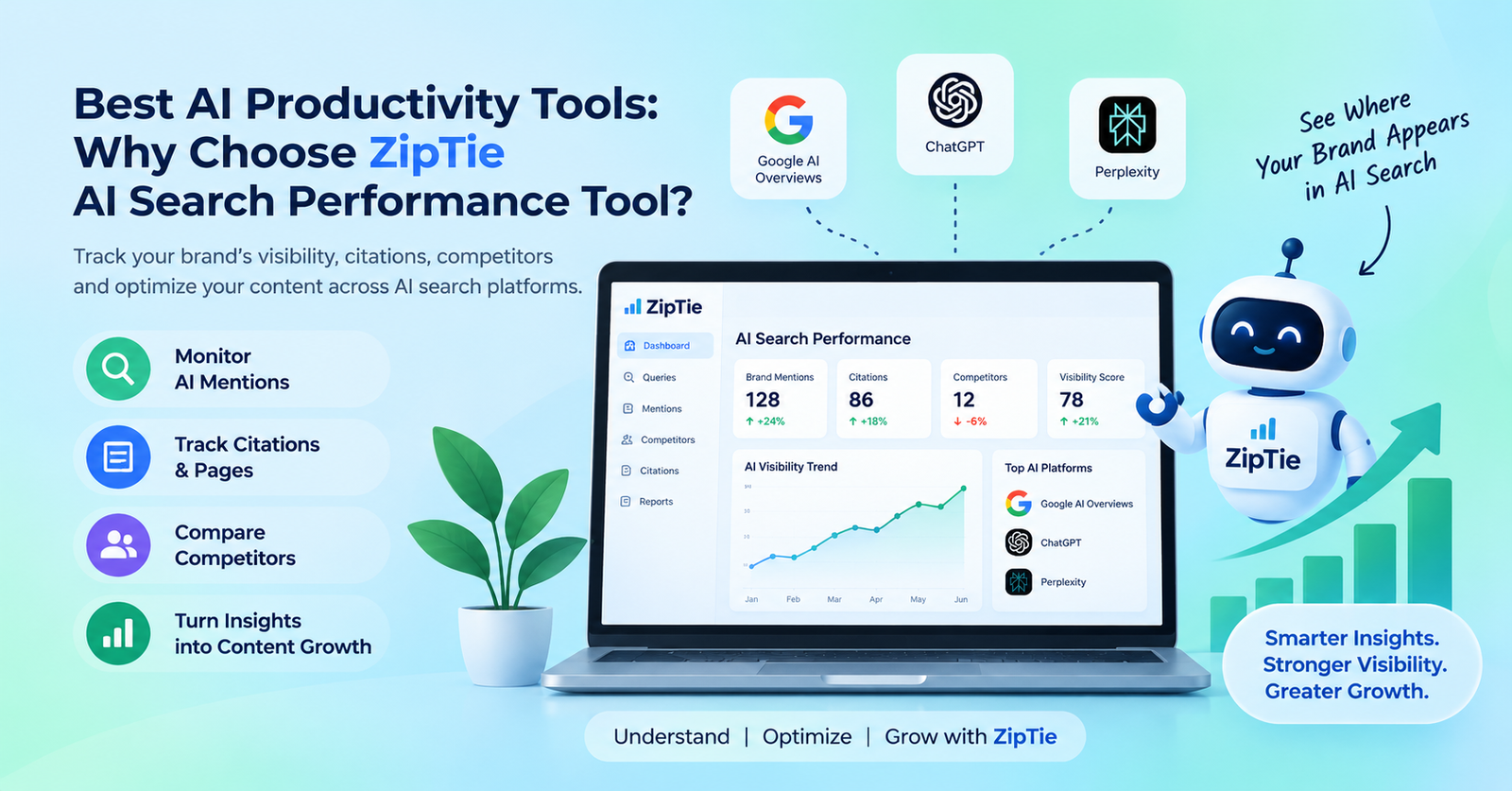
AI search has transformed the way consumers find brands, products and information. Users now ask ChatGPT, Perplexity and Google AI Overviews to provide answers to full questions, not just search engine results.
This poses a new challenge for SEO teams. Even though a website gets a good rank on Google, it may not be seen in the AI-generated answer.
This is the reason why companies are beginning to monitor the visibility of AI search along with SEO. Brands can be tracked with tools like ZipTie to see where they are showing up, the pages where they are cited and how their competitors are doing on AI search platforms. Currently, ZipTie is concentrating on Google AI Overviews, ChatGPT and Perplexity.
Traditional SEO tools are primarily used to monitor rankings, clicks, impressions, backlinks and organic traffic. While these are key metrics, they aren’t comprehensive of the experience of AI search.
An AI search performance tool concentrates on the following questions:
A software business can occupy the top spot in Google’s rankings for best CRM for small businesses. But when a potential customer asks ChatGPT the same question, the AI answer could list three competitors and bypass that company.
This disparity might not be apparent from traditional rank tracking. AI search monitoring can assist in the identification of it.
Choosing the ZipTie AI search performance tool becomes important when a business wants to understand what actually appears in AI-generated answers.
ZipTie is not just a small module within a typical SEO platform; it’s dedicated to monitoring AI search. It is currently monitoring AI Overviews in Google, ChatGPT and Perplexity.
The platform isn’t just about counting brands mentioned; it’s also about monitoring how they are being mentioned.
It can interpret citations, competitor visibility, answer context and more, which can provide insights into a brand’s presence in AI search. That distinction matters.
For those seeking to grow freelance income, Incomrise provides practical tips and resources about freelancing, side hustles, earning online and digital work.
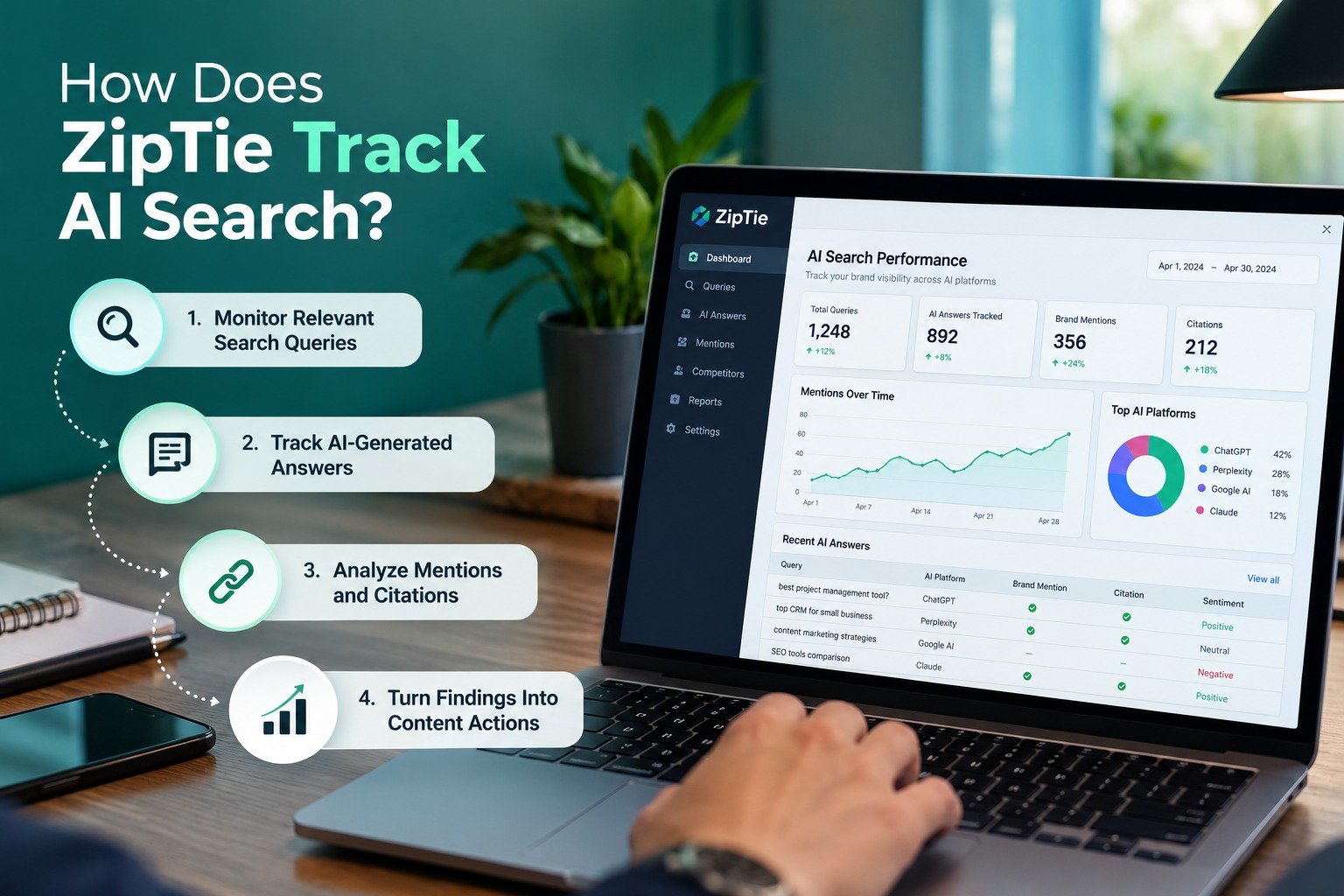
The first step of AI search is taking in natural language questions. These can be query searches, comparisons, product recommendations or queries for specific issues.
ZipTie can create relevant AI search questions based on URLs of content. It even offers query generation features with information from Google Search Console to create a monitoring set based on current search behavior.
The platform tracks the queries selected and their appearance in the supported environments of AI search. This is crucial because AI platforms aren’t always going to give the same answer for a particular question. It’s possible for a brand to show up on one platform and not another.
The data can be used to determine if the brand is referenced in an answer and if the brand’s website is cited. The teams can then determine if important queries are given visibility to certain pages and competitors.
Tracking isn’t just for numbers. The results can assist the content teams to improve their pages with better answers, better supporting information, or better topical coverage.
ZipTie AI search intelligence empowers enterprises to comprehend the AI platforms’ statements with regard to their brands and competitors. This can be particularly beneficial when conducting competitor research.
If three competitors keep popping up when people query for a specific product category, suppose they are. A marketing team can analyse pages of its competitors that are cited and the information they offer. The intention is not to make copies of those pages. Its purpose is to find relevant gaps in content.
For instance, an article that answers a question clearly, explains a complex process in an easy-to-follow manner, or offers original data may earn citations. Those learnings can impact content strategy going forward.
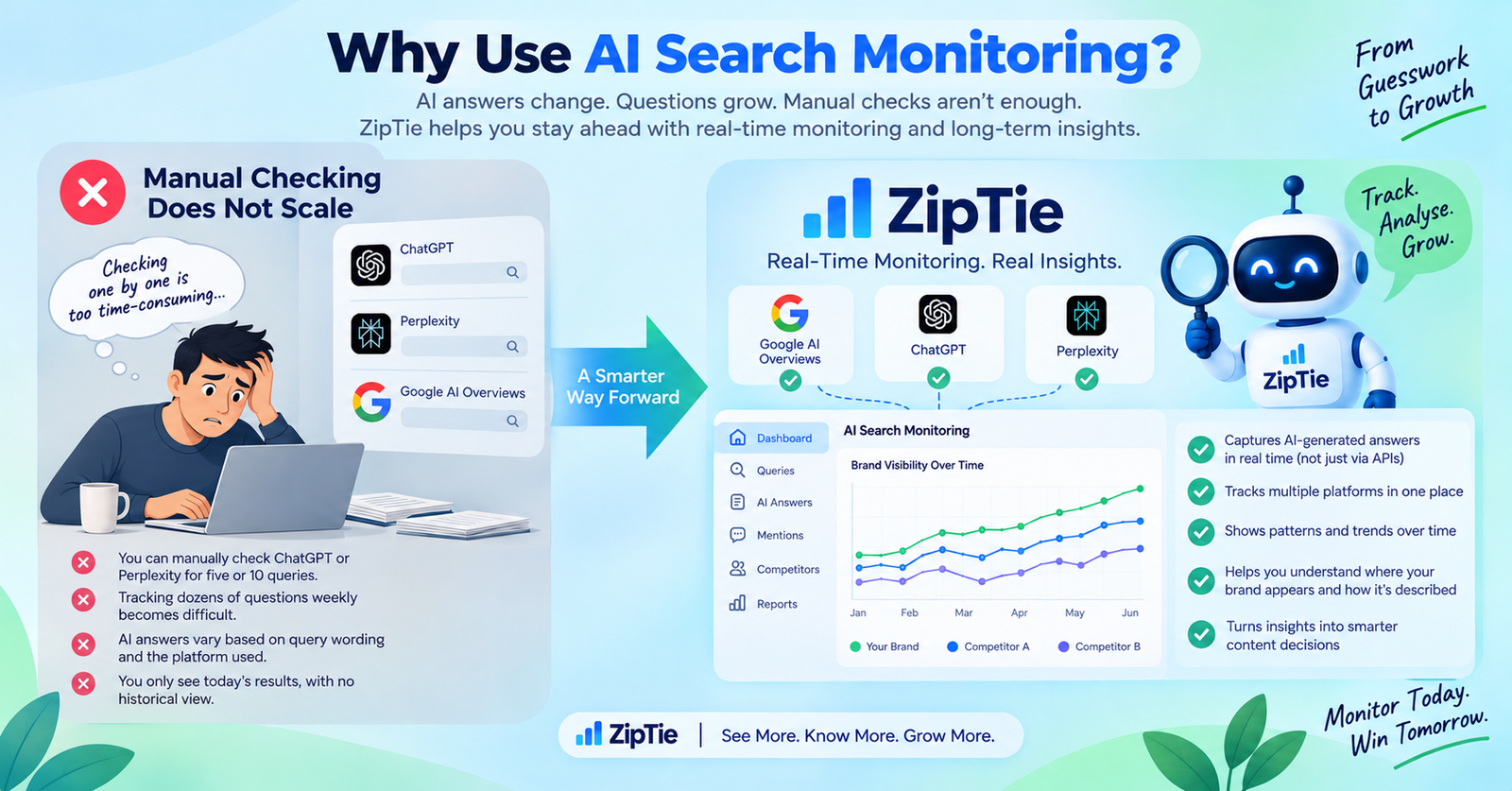
You can manually check ChatGPT or Perplexity for five or 10 queries. When you want to keep track of dozens of informational and commercial questions weekly, it gets a little difficult.
AI answers may also vary with regard to the query wording and the platform used. Furthermore, ZipTie places a special emphasis on capturing AI-generated answers in real time, not just through API analysis. This record of these changes is provided by regular monitoring. Instead of asking, “Did our brand appear today?” teams can look for patterns over time.
ZipTie AI visibility tracking is another addition to the SEO and content teams’ search data.
The organic results of Google are the ones that traditional SEO asks questions about. AI visibility tracking analyzes the answers that are created and the sources of the answers. AI visibility tracking gives teams another layer of search data. Understanding brand visibility in AI search engines can also help teams identify which content earns attention from AI platforms.
Now imagine that a page is listed in Google’s top 10 results but it has no AI citations. This does not necessarily imply that the page isn’t good. It just means that rankings and AI visibility are two different signals.
Teams can use both datasets to investigate why.
For example, they can compare:
This creates a broader view of search performance.
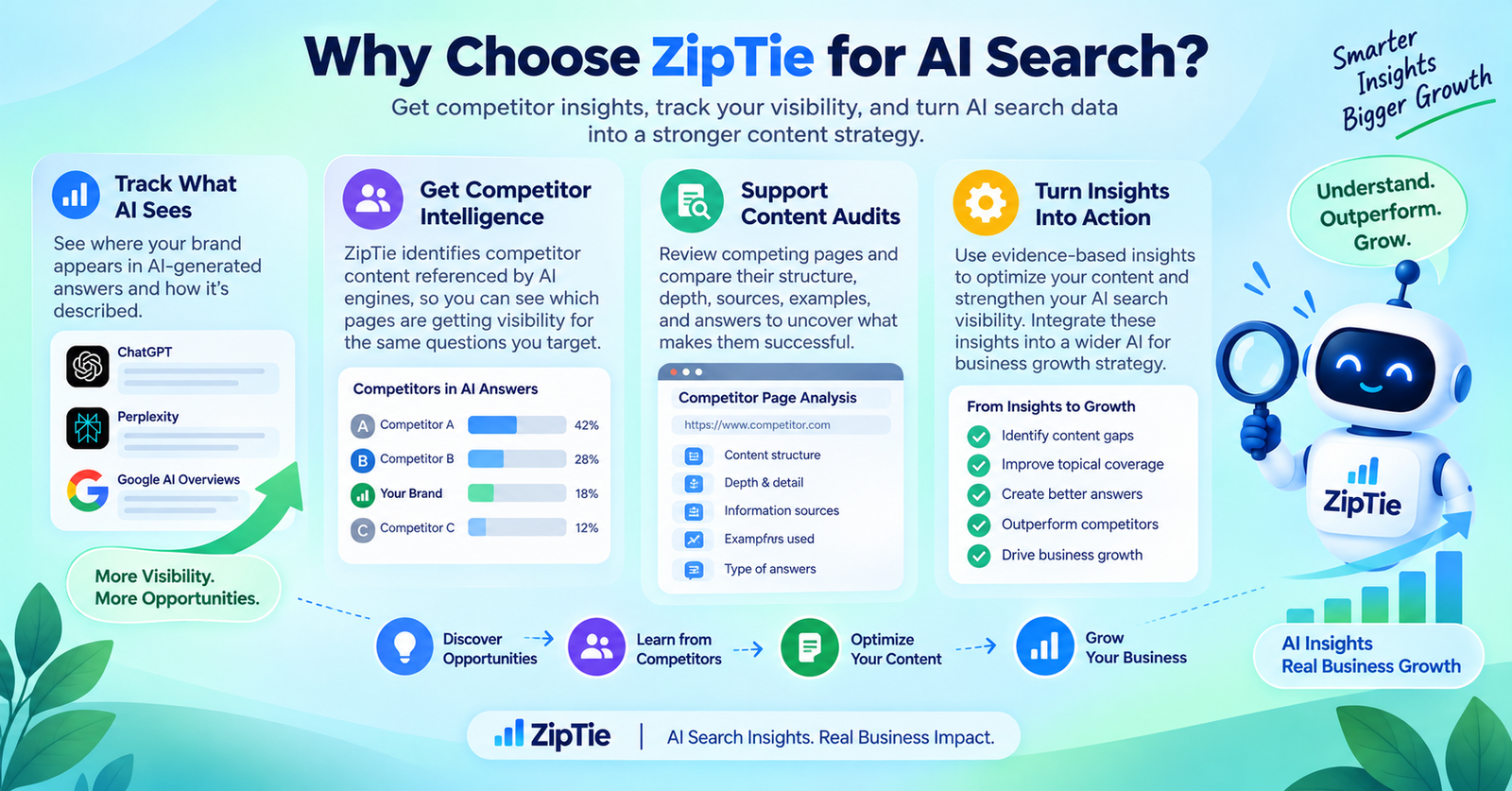
The ZipTie AI search performance tool method also makes sense if teams would like to get competitor information as well as visibility tracking.
ZipTie defines competitive intelligence attributes that detect competitor content referenced by AI engines. This assists marketers in observing which pages are attracting visibility to the very same questions they’re aiming at.
This information can be used to aid in Content Audits. Both teams can review the competing page and compare how it is organized, how deep and how detailed it is, where it gets its information from, what some of its examples are, and what its answers are.
This leads to an optimization process that is more evidence-based. AI search insights can also be integrated into a wider AI for business growth approach, enabling businesses to gain deeper insights into customer discovery and assessment of brands.
AI search optimization is about creating content that is easy to understand and access for the AI search system and that is useful and clear. It’s not about stuffing articles with keywords or writing articles just for robots.
Fundamentals continue to be important:
A ZipTie AI optimization tool can then help teams identify opportunities based on what AI search results and competitor citations show.
This creates a practical cycle:
Create useful content → monitor AI visibility → identify gaps → improve content → monitor again.
Good ZipTie AI search analytics should help answer business questions, not simply produce a dashboard full of numbers. Useful areas to monitor include:
How often does your brand appear in relevant AI answers?
Which pages from your website are cited as sources?
Which competitors appear when your brand does not?
Which questions produce visibility and which important questions remain uncovered?
How does the AI answer describe or position your brand? These signals become more valuable when reviewed over time rather than treated as isolated results.
Ultimately, the choice of search performance tool is left to the team to decide, depending on what they wish to measure.
If your company spends a lot of money on content, ranking alone is not a complete indicator of how many places your brand can be found. AI-generated answers create a new context for searching that can be tracked.
ZipTie integrates query monitoring, brand visibility, competitor insights, citation tracking and AI search optimization into a single solution. It has recently expanded its efforts to include Google AI Overviews, ChatGPT and Perplexity.
AI search has become an additional dimension in SEO. While ranking on Google is still significant, it is not the only metric that can provide insight into the discovery of brands online.
For teams seeking tangible insights into AI-driven search results, the Choose ZipTie AI search performance tool is a valuable option to consider.
Businesses can track queries, mentions, citations and competitors to gain insight into where their content gets visibility and where it’s lacking. But most importantly, they can leverage those results to produce more meaningful and relevant content for both search engines and actual people.
ZipTie is an AI search monitoring platform that allows businesses to monitor the presence of their brand and content in AI-generated search results. It has recently expanded its efforts to include Google AI Overviews, ChatGPT and Perplexity.
ZipTie is able to track queries and analyze the AI answers generated. It monitors and records brand mentions, citations and offers competitive AI search visibility insights.
AI platforms can give suggestions and refer to other sources rather than traditional search results. Monitoring can be used to track if the brand is mentioned in the appropriate AI responses and to identify any areas where the brand is not being mentioned.
No. Traditional SEO and AI search have different expectations of search. Combining all these factors, such as organic rankings, website traffic, backlinks and AI visibility, can offer a comprehensive perspective of search performance.
A mention is when AI’s response includes a brand or entity. A citation will refer the reader to a source, typically a page of a website. These are the various signs that give different information regarding the visibility of a brand.
Yes. With AI search optimization, ZipTie offers team members insights into content opportunities based on AI search and competitor citation data.