
Edited by
M. Ibrahim

Reviewd by
Abdul Qadir

Edited by
M. Ibrahim
Reviewd by
Abdul Qadir

Notion templates for sale can be an excellent product to monetize and give you an income stream online. Create a template, put it up for sale and allow customers to buy and duplicate it without you having to put in the effort to create one for each order.
Key: Solve a real problem. Students need more effective study planners, freelancers want systems to track their projects and small business owners want systems for managing their clients. A handy template helps save time and simplify activities.
In 2026, the key factors to consider when how to sell Notion templates are: finding the right audience, building a valuable product, selecting an appropriate platform and promoting consistently. It is not necessary to be equipped with a large setup, but it is essential that you have a strategy.
All the time first, relax and determine a problem individuals are looking to remedy before constructing a template. You can focus on a particular audience which makes your product easier to design and market. Incomrise provides easy-to-follow tutorials about digital products, online businesses and side hustles, to help novices discover some of the possibilities of making money online.
Use Notion communities, Reddit discussions, social media comments and existing product listings to explore. See if there are any recurring queries regarding productivity, organisation and business administration.
These are some product ideas that you should investigate:
The following ideas are suggestions, not guaranteed to be bestsellers. Do research on other similar products, reviews and search interest before putting time into developing.
If you choose an idea, create a template that seems to be intuitive and effortless to use from the first click. Notion provides the ability to build databases, calendars, task lists, connected pages, formulas and filtered views within it. Link these features only if there is an enhancement of the user experience.
Follow these steps:
In your product description, include a brief installation tutorial and have some clear pictures of the product. Purchasers would like to understand what they are purchasing and how soon they will be able to use it.
The answer to the question where to sell Notion templates is going to vary based on your audience, preferred payment method and the selling functionality that you have available. Before opening an account, check out the platform fees, seller eligibility and payment availability.
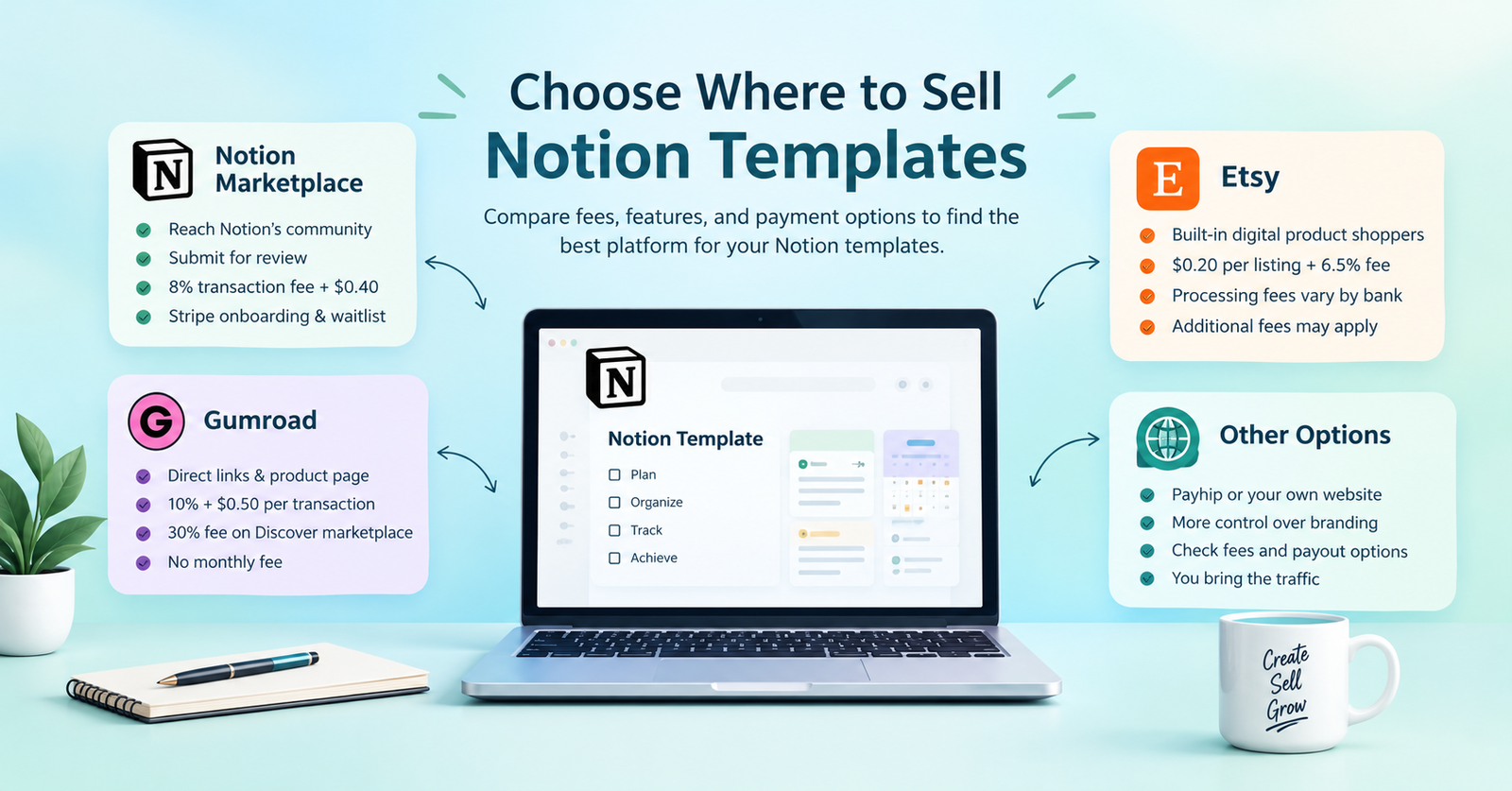
The Notion Marketplace enables users to find templates in Notion’s home ecosystem. Templates can be provided for evaluation and approved listings can be brought to the attention of people who are already shopping for Notion solutions.
Anyone is able to develop a template and then submit it for review in the marketplace, according to Notion. However, Direct payments are independent of the approval process, have a waitlist and need to be onboarded with Stripe.
For direct Marketplace sales, Notion takes a 1% currency conversion fee and an 8% transaction fee plus $0.40 for creators outside the United States. Eligibility for the countries and the requirements for payment are in effect. This is a great choice for creators aiming to cultivate a following in the Notion community.
Etsy might be a place to consider as customers are already looking for planners, productivity systems and digital downloads. Using listing images, product descriptions and instructions that guide buyers to their duplicate links, you can sell Notion templates on Etsy.
Etsy has a 6.5% fee for every transaction and $0.20 per listing. Payment processing fees differ depending on the bank in the country that the seller is from. Other fees may apply, including setup and/or advertising fees. Creators who are looking into selling digital products on Etsy can also learn how to start their shop, list their downloadable products and how to lure potential customers.
Gumroad makes it easy to directly sell digital products. You can make a product page, upload a PDF help guide and give access to your Notion template.
Note that at the moment, Gumroad takes a 10% commission on all sales using your profile or links, or a $0.50 per sale fee (whichever is more), without the payment processor fee. It takes a 30% (including processing) cut of all sales made on its Discover marketplace. No membership subscriptions are required. The methods of receiving payouts vary from country to country. It’s effective if you’re going to draw in customers via your blog, social media or e-mail list.
You can also check out Payhip or your own website as long as they have the same payment and seller guidelines as you. A personal website gives you greater control of branding the site and your customer relationships, but you’ll have to drive traffic. Don’t just select the most popular platform; make a comparison of all fees and payouts.
Good Notion template pricing reflects the value of the product, its complexity and the needs of your audience.
Here is a practical starting point:
| Template type | Example price |
|---|---|
| Basic checklist or planner | 9 |
| Student or habit tracker | 15 |
| Freelancer dashboard | 35 |
| Advanced business system | 75+ |
These are recommended minimum prices (not market prices). Compare products and make price adjustments for quality, demand and customer feedback.
This simple habit tracker can be priced at $5, while the detailed client management system with multiple databases and instructions on how to set it up can cost up to $29. Find out how much you have to expect when you consider fees attributable to the platform. For instance, if you have 20 sales of a $15 template, you will have $300 of gross revenue without fees, refunds and taxes.
If a product is not listed and its value is not explained, it is not a useful product. Effective Notion template marketing starts with a concise title, handy screenshots and a description that addresses buyers’ questions.
Instead of using a generic title like “Ultimate Workspace”, opt for something more descriptive that tells users what the app is and why it’s useful, like “Freelance Client Tracker for Notion.
Here are a few things to put in your listing:
Use appropriate search terms in the title, description, tags and image text (when applicable) for Notion template SEO. The words buyers will find and search for in a listing, not words that they repeat over and over.

An ad budget is not required to get the ball rolling towards potential customers. The best way to get free promotion is to regularly post informative material where it will reach your target market.
Try these methods:
Publish short tutorials. Demonstrate the use of your template to visualize the weekly schedule, freelance projects or assignments. It can be better explained to buyers through demonstrations.
Post useful content in the appropriate community. Respond to groups and productivity forums on Notion. Be sure to abide by the rules of the community and refrain from posting sales links in areas where they are not allowed.
Take advantage of Pinterest and brief videos. Make well-organized visuals that display your dashboard before and after you organize it. Connect people who are interested in your product to your product page.
Create an e-mail list. Provide a free mini-template or checklist and accept subscriptions. Share helpful advice and promote sales of connected paid products.
Make a mini content site. Create tutorials about issues that your templates address. When you write articles like “How to Organize Freelance Projects in Notion”, you’re going to find that they will attract some of the people who already have an interest in your product category.
Choose one or two channels that you can keep up with at all times. It’s more important to post useful content and relevant traffic than it is to post everywhere.
The first sale may be from a product that addresses a single problem for a relevant audience.
Use the following easy-to-follow launch plan:
If it’s appropriate for the price structure, you can give it a limited launch discount. Don’t create an artificial shortage or make claims of guarantees.
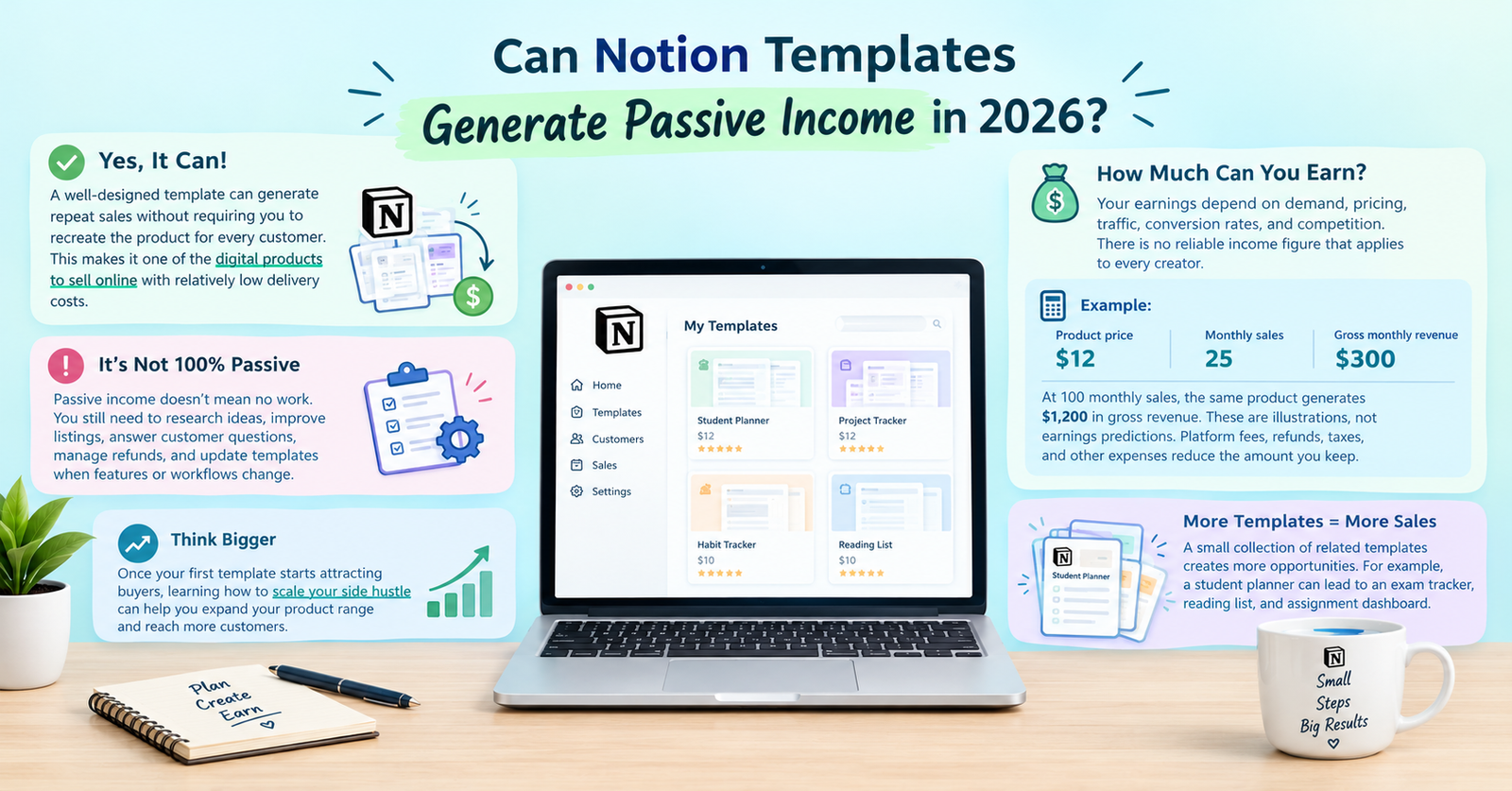
Yes, a good template can produce repeat sales, but you don’t have to re-create the product for each customer. This makes it one of the digital products to sell online with relatively low delivery costs. But passive income isn’t necessarily income without effort. When features or workflows are changed, as well as researching ideas, enhancing listings, responding to customer questions, handling refunds and updating templates, all of that still has to be done.
Once your first template starts attracting buyers, learning how to scale your side hustle can help you expand your product range and reach more customers.
This is where the competition, conversion rates, traffic, pricing come into play and your earnings vary according to those factors. Unfortunately, for every creator there is no definitive income number.
Consider this example:
When this product is sold 100 times a month, the gross revenue is $1,200 per month. These are only pictorial forecasts and not forecasts of earnings. Platform fees and refunds, taxes and other costs take away from your profits.
First and foremost, learning how to sell Notion templates begins with understanding buyers and producing a product that saves their time. Select a specific concept, create an effective and valuable workspace, research selling platforms, establish a reasonable price and market your listing with strategic, appropriate content.
Think of your template shop as a mini website. Put ideas to the test, listen to customers and make changes to the products as needed. Over time, your templates can ultimately be a means to repeat sales if you work hard enough.
They are a great business, but there is competition. Templated solutions to specific problems and solutions that present a user-friendly experience have more of a purpose to stand out.
No, Notion’s visual tools enable you to create pages, databases, calendars and dashboards without coding anything. Advanced formulas and integrations can be provided, but are optional.
Yes. Use a simple template, do some careful testing and get feedback from customers before moving on to developing more complex products.
Design a useful product, post it on the right platform and get the right traffic. Keep the product up to date and enhance the item listing as customers’ needs evolve.
A single beautifully designed template is sufficient to gauge interest. Add to your product range once you’ve figured out what your audience is interested in and what products you can sell.