
Edited by
M. Ibrahim

Reviewd by
Abdul Qadir
Edited by
M. Ibrahim
Reviewd by
Abdul Qadir
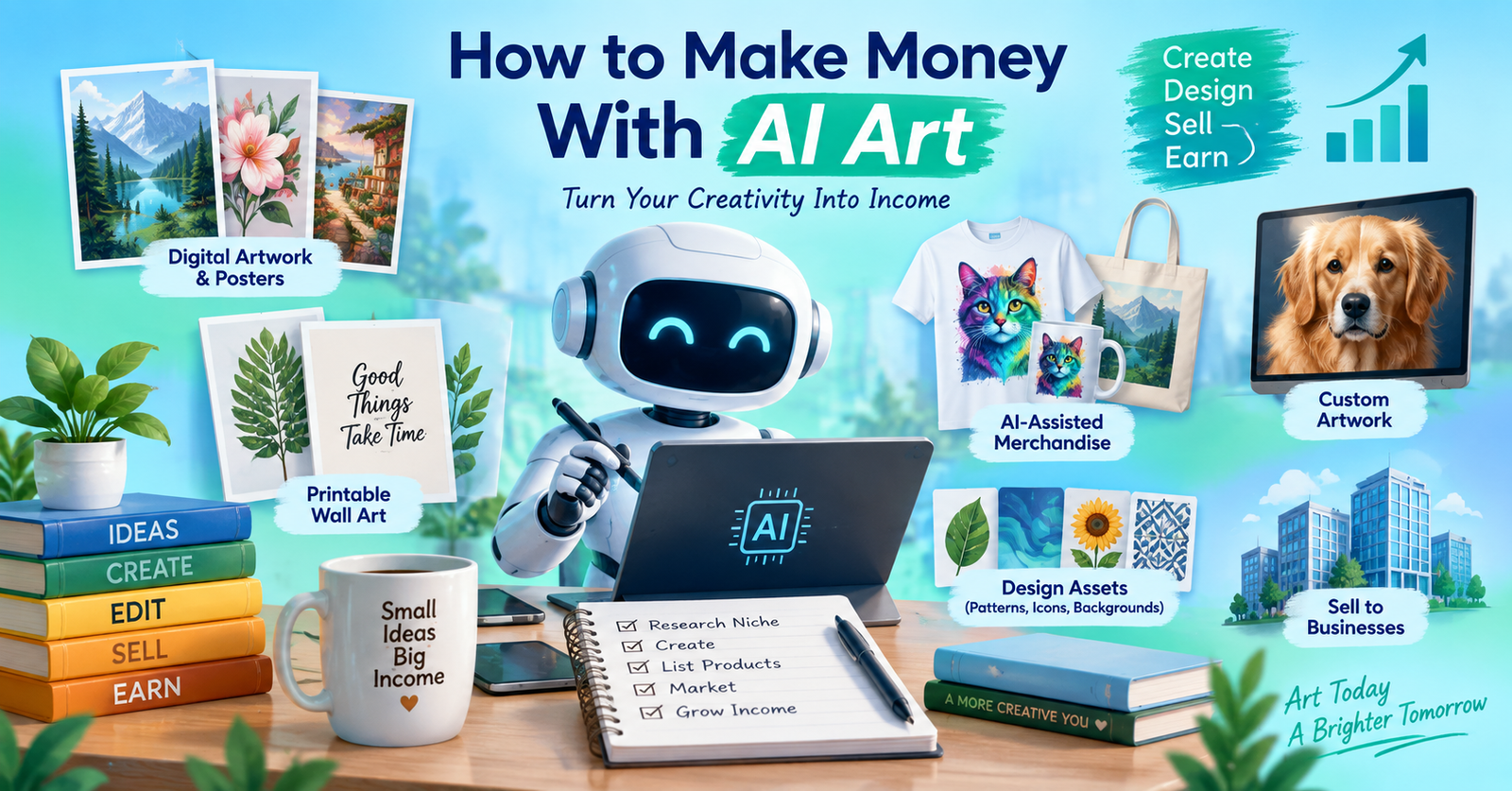
Creating appealing artwork with AI is just the beginning of the process of making money from it. The actual job is selecting a helpful niche, producing unique products, editing pictures, presenting them nicely and securing buyers. When considering how to make money with AI art, keep in mind that you should be selling a solution or product instead of spawning random AI images and posting them somewhere.
Digital Artwork, Posters, Backgrounds, Patterns and themed collections can be sold as digital products. If you’re interested in other alternatives to AI artwork, our article on best digital products to sell has you covered for other products you can make and sell online.
Yes, but AI art isn’t a sure bet for sales. Artwork is purchased based on a purpose, a polished look, time-saving and/or taste.
For instance, a general fantasy suit is of low gain of its own. Twenty botanical prints, all coordinated, have a more obvious purpose as home decor.
The best AI art sellers take human input at each step in the process. They conduct research on demand, develop concepts, correct visual errors, edit outputs, prepare files, write product descriptions and market the finished products.
Incomrise provides practical advice on using AI to earn online, with guides on AI tools, side hustles and earning online through digital means.
There isn’t one business model that fits every creator. These are some practical ideas that you can consider.
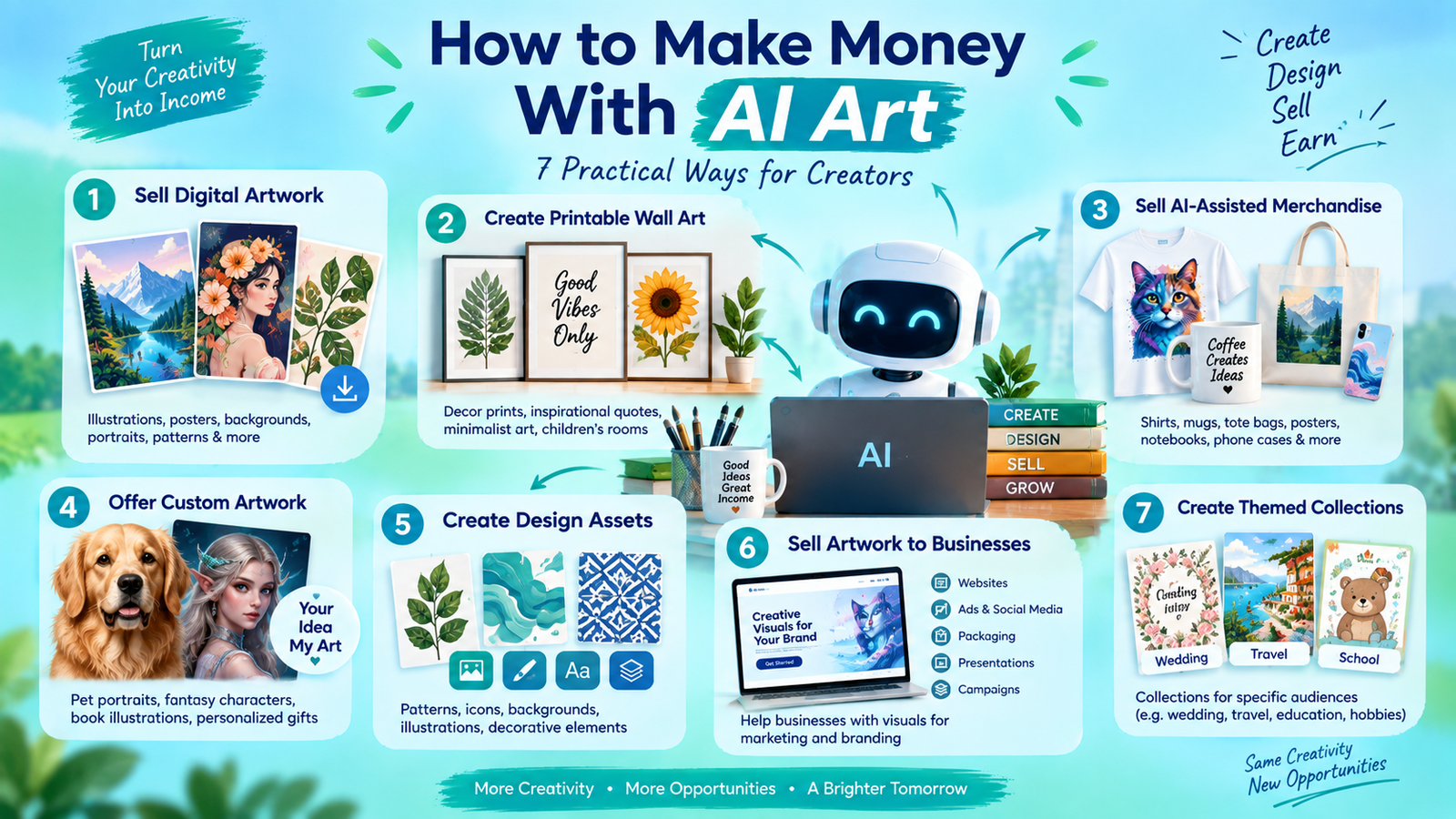
Illustrations, posters, backgrounds, portraits, patterns, themed collections and more can all be created as digital artwork. The files are downloaded by the buyers instead of being shipped to them. This makes fulfillment easy, since there is no packaging and shipping of each order.
One focused collection is enough for a beginner to begin with. For instance, make 15 botanical prints in the same style, edit them meticulously, export typical sizes and make nice mockups. There’s competition for the challenge. Having hundreds of similar images doesn’t make a good product catalogue.
Printable wall art is good for when the art is used for a particular décor theme or particular audience. You can create collections on subjects like minimalistic prints of plants and flowers, inspirational typography, illustration for children’s rooms, or anything you really enjoy.
It’s not about the computer here; it’s about the human work. Review images for quality, crop the artwork properly, create multiple ratios and ensure that customers know exactly what they are getting. It’s also helpful to have a product page with clear instructions and previews on how to download and print the files.
Print-on-demand (POD) services are available to create AI-generated artwork for various products, including shirts, mugs, posters, tote bags, notebooks and phone cases. You can concentrate on artwork, product choices, listings and promotion, and the platform or production partner will take care of manufacturing and shipping.
Do not post the same design on every website; confirm the rules of each website to be sure that the design will display correctly. There are services that have specific needs for AI content, commercial rights or disclosure.
Custom work can generate revenue that doesn’t rely on 100% passively generated digital sales. Pet Portraits, fantasy characters, book illustrations, social media graphics, and personalized gifts might be requested by customers.
While AI can provide ideas, the final product needs human oversight. Correct for disagreeable anatomy and composition, eliminate extraneous information and alter the painting to the client’s specifications.
Graphics like patterns, backgrounds, icons, illustrations and decorative elements are used in design and business.
They can be made in thematic asset packs, rather than selling single images. A pack can include social media backgrounds, floral graphics, business presentation graphics or seamless patterns.
At this time, Adobe Stock is accepting submissions of generative AI images, vectors and videos from users who adhere to its licensing, quality, labeling and submission standards. Adobe also asks contributors to mark up any generative AI content in submissions.
Artwork isn’t always a business’s aim for decoration. They frequently require images for websites, advertisements, packaging ideas, social media posts, presentations and campaigns. This is an opportunity to sell creative services, not individual images, with the assistance of AI. The benefit is that you are selling a service for a definite business goal.
Collections can add value to your store beyond a collection of images with no relationship to the site. Select an audience and develop around it. Wedding stationery graphics, school illustrations, travel posters, or illustrations for an interest may be collected.
This is one of the more practical ways to make money with AI art because a collection provides the customer with several different related products to investigate.
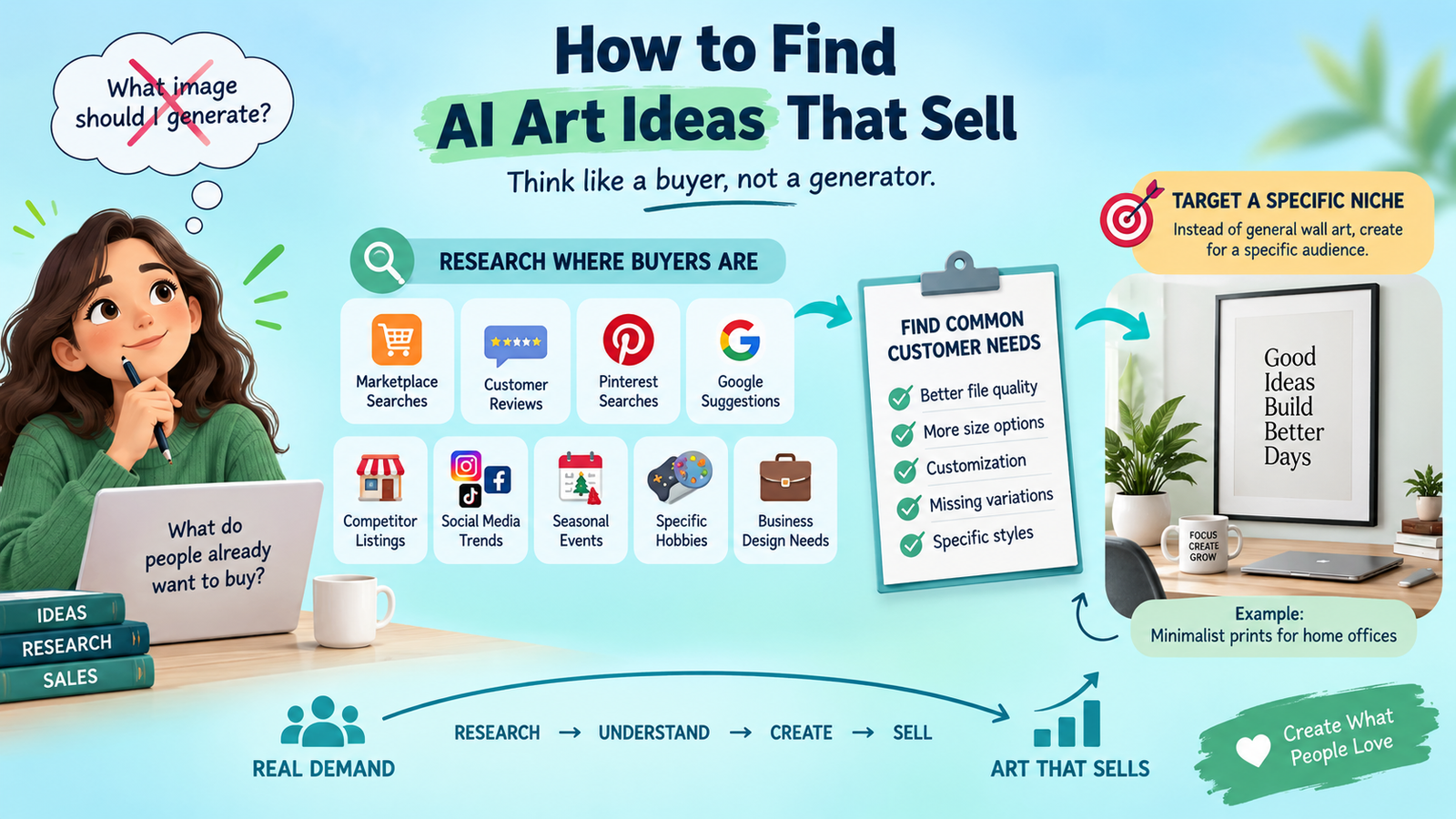
Don’t start with the question, “What image should I generate?” Start with, “What does someone already want to buy?”
Research:
Identify common customer requirements. Reviews can highlight issues with file quality, sizes, customization and missing variations. Positioning can also be facilitated within specific niches. Rather than “wall art”, have your prints commissioned for a specific group, like for a minimalist home office.
Each marketplace is best suited for a specific product and its AI policy.
Alternatively, you can have your own website, creator storefront, or print-on-demand. Before uploading, be sure to review the current policy as platform policies may vary.
Selling AI art for profit requires more than setting a price.
Start with your total costs:
Profit = Revenue − platform fees − production costs − software costs − advertising − other expenses
For digital products, production costs can be relatively low, but your time still has value.
Consider these illustrative calculations:
These calculations are for illustration only, not to be relied upon as earnings. Actual profit will depend on demand, pricing, fees and taxes, refunds, advertising costs, software costs and production time.
Do not use the first version that you create; keep it small. Select an audience and product type. Make a list of 10-20 related products. Carefully edit each image and create professional mockups.
Afterward, list the products on a platform that allows for the type of AI content you are. Monitor views, clicks, saves, inquiries and sales of products. Use those signals to make your next collection better instead of hundreds of images that aren’t related to the signal.
Research, creation, editing, file preparation, listing and promotion are repeatable processes that make an AI art business easier to manage.
The legality of AI art is complex and subject to interpretation depending on the country and is still evolving. Be aware that not all AI-generated images are copyrightable.
Prior to offering artwork for sale, verify:
If the project has a legal or financial impact of significance, review the latest official guidance that is relevant to your country.
AI works best as a creative and production assistant.
Good results depend on more than writing a prompt. You still need to:
AI-generated images can sometimes fall flat due to their low effort and repetition. Human Judgement provides direction to a collection of items and makes it more useful to the end user.
The best way to how to make money with AI art is NOT to create a ton of images. Pick one niche and assemble a small library of valuable products, completed with a bit of artwork; experiment with demand testing before spending a lot of money.
Use AI as a tool in your creative process and not the business itself. Your research, editing, presentation, understanding of your customer and marketing make generated images into products that people will have a reason to purchase.
Yes. Digital Artwork, Printables, Merchandise, Custom Designs, Stock Assets, and Creative Services are all types of things that people can sell. Income is based on the demand, product quality, marketing, costs and platform rules.
Keep it simple with one niche and a handful of products. Edit all images, build helpful file formats, make compelling image previews and list products on sites that allow the type of AI-created content.
This can be done through Etsy, Adobe Stock, personal sites or creator storefronts and appropriate POD. Research the existing AI policy for each platform before listing products on them.
It may be, but the legality depends on the content, AI tool, licensing terms, rules of the marketplace, IP rights and applicable law. AI copyright laws are also country-specific.
Yes, often, but it will depend on the license of the AI tool and the content itself. Before working with an image in a current product or client project, review the current terms of the tool.