
Edited by
M. Ibrahim

Reviewd by
Abdul Qadir
Edited by
M. Ibrahim
Reviewd by
Abdul Qadir
AI-generated artwork is an excellent alternative for those who don’t know how to draw, allowing them to make digital artwork, sell prints and license images. The best platforms to sell ai generated art 2026 include marketplaces for digital downloads, stock image websites and print-on-demand services. The platforms will offer varying amounts of pay, rules and opportunities.
It’s not necessary to have a website of your own to begin. You can upload original artwork, select the appropriate marketplace and market your products to potential customers. But, having good art, having a demand, setting a price and having consistent marketing is necessary.
Here are 12+ websites for you to earn money from, how they earn money and what the rules are to consider before selling your work.
Digital marketplaces, stock libraries, print-on-demand sites and personal storefronts are all places where sell ai art online can be utilized. It will depend on whether you’re selling downloadable files, physical products or commercial licenses. Artists can explore different ways to make money with AI art, from selling digital downloads to licensing their work on online marketplaces. Incomrise provides practical information on how to leverage AI, sell digital products and explore online income opportunities.
When it comes to AI art marketing, these are the best websites for selling AI art in 2026.
Etsy is a great place to sell personalised portraits, printable wall art, invitations and digital illustrations. Your files are bought by your customers and then they print them from home or a print shop. The use of AI in seller-initiated products is permitted on Etsy, but sellers are required to state that they used AI when describing the product. AI prompt bundles for sale separately are not allowed based on its creativity standards. For beginners who want to sell digital items on Etsy, printables, illustrations for download and collections of artwork on a theme are a good place to begin.
How you earn: Sell digital downloads or physical prints. Etsy fees include listing, transaction and possible payment-processing and other charges. Make sure to review its current fee structure prior to establishing pricing.
Adobe Stock allows for AI-generated illustrations, vectors and videos provided they are of acceptable quality and comply with the licensing terms. Contributors get royalties when people license the approved assets. Correctly label AI-generated content and have commercial rights. Prompts and metadata must also abide by Adobe’s restrictions on third-party IP.
How you earn: Receive royalties from licensed downloads. Check the current terms for Adobe contributors’ royalties and uploads and submit work accordingly.
Dreamstime will accept AI-generated content with certain conditions. Contributors are required to categorize the AI work and include its AI origin in the title or description. Human faces are generated faces that are subject to additional restrictions.
How you earn: Sell your original pieces of artwork, backgrounds and other appropriate stock images. Incentives are based on the number of licenses sold and the terms of the contributor.
Freepik is a stock-content marketplace that provides illustrations, vectors and more. For artists who are working on commercial graphics, its contributor program is another alternative. Please read the current rules for contributors about what can be uploaded, technical requirements etc. and labels before you submit your file.
How you earn: Get contributor payouts when customers access or license program-qualified content as per the program’s payment terms.
123RF is essentially a stock content website that permits contributors to bring in accepted visual possessions. Consider using for commercial illustrations, backgrounds, patterns and more. Be sure to read its most recent AI submission guidelines. AI-generated assets might need a specific category and should conform with the technical and intellectual property guidelines of the site.
How you earn: you will earn money based on the number of customer licenses of accepted images. Rates are contingent upon the agreement with the contributor and licensing.
Redbubble is a website that connects individual artists with customers who are seeking art for a variety of products including telephone cases, accessories for the home, clothing and stickers. It is a POD (print-on-demand) which takes care of product production and delivery. Please keep in mind the current content and intellectual property policies before uploading artwork created by AI. Be sure to have commercial rights to any design and elements used.
How you earn: Receive a set of product designs and collect artist margin on eligible sales. The account charges and calculation of earnings may impact your closing profit.
Creative Fabrica is dedicated to a digital creative resources section including graphics, fonts, illustrations and craft designs. It works for artists who are producing downloadable assets for designers and/or small businesses. Check its AI Content policy and seller conditions prior to publishing. The format of the papers accepted, disclosure rules and payment vary by program.
How you earn: Either selling eligible digital assets or earning by making downloads as per the platform’s contributor model.
Zazzle enables creators to design customizable products such as cards, posters, invite and giveaways. When it aligns with the platform guidelines, AI artwork can be a springboard for original product design. Review its current policies for content and ensure that your design does not use any characters, logos, or other works that are protected.
How you earn: Royalties will be paid on product sales if your product meets the requirements, according to your royalty rate and the terms of Zazzle.
Gumroad can be used to help any company sell its digital products directly to its customers. You can provide art files, themed collections, printable posters and packages for commercial use. It is effective for those who already have followers and/or are looking to promote products via social media. Check its current rules and fees for prohibited content prior to launch.
How you earn: Set prices for products and get money when they are sold (after applicable fees).
Ko-fi provides creators with an easy-to-use online store for digital downloads, commissions and more. It can be used to sell artwork without the need to create a complete e-commerce website. Be sure to comply with its existing content policies and that you have the right to sell all images.
How you earn: Digital file sales, custom art or commissions. The platform and payment processing fees will vary depending on the features and payment structure that you are using.
Payhip allows creators to sell their digital downloads with a storefront. It’s ideal for printable art packs, desktop wallpapers, coloring pages and downloadable illustration packs. Before posting, review its existing terms to ensure that they do not include any restrictions on AI-generated content, intellectual property or certain products.
How you earn: Set your own prices and sell single files or packages. Payhip’s fees and payment processor fees will impact your net earnings, based on the plan.
Fine Art America is a company that specializes in art prints and artwork products from independent artists. It may attract artists who would like to provide wall art of various sizes and formats. Before building a portfolio, check its existing AI-art acceptance policy. Be sure to review its content requirements and the difference between the base product cost and your mark-up.
How you earn: Make eligible prints or products and receive the appropriate markup or royalty, in accordance with the current terms of the platform.
ArtStation is a digital artist and illustrator portfolio and marketplace. It can serve artists to showcase polished collections and to connect with audiences of digital art. The AI rules and marketplace eligibility may vary, so be sure to review the latest conditions before postings AI-generated content.
How you earn: Where allowed, use marketplace features on supported digital products or artwork to sell. Your portfolio can also be used to find direct commissions.
Shutterstock is not only a huge stock content marketplace, but its contributor policy does not permit any AI-written content from its contributors. Please note that it is not a solution for uploading AI-generated images for royalties. Instead, explore other stock libraries that make it clear that they accept eligible AI-generated assets.
Art prints, home decor and more with designs by independent artists are available at Society6. But its AI content guidelines and existing artist eligibility requirements should be reviewed prior to considering it for AI art.
How you earn: If the job meets the requirements in terms of current requirements, payments will be based on what the company offers and the payment system.
| Platform | Best use | Earning method |
|---|---|---|
| Etsy | Printable art | Digital product sales |
| Adobe Stock | Commercial illustrations | Licensing royalties |
| Dreamstime | Stock images | Licensing royalties |
| Freepik | Graphics and vectors | Contributor payments |
| 123RF | Stock illustrations | Licensing commissions |
| Redbubble | Stickers and clothing | Artist margin |
| Creative Fabrica | Digital design resources | Sales or eligible downloads |
| Zazzle | Custom gifts and prints | Product royalties |
| Gumroad | Digital art bundles | Direct sales |
| Ko-fi | Downloads and commissions | Sales and commissions |
| Payhip | Printable collections | Direct sales |
| Fine Art America | Art prints | Sales and markup |
| ArtStation | Digital art portfolios | Eligible product sales |
The rules and terms of payment for platforms are subject to change. Always check the eligibility for AI, fees and payouts before investing time into a store.
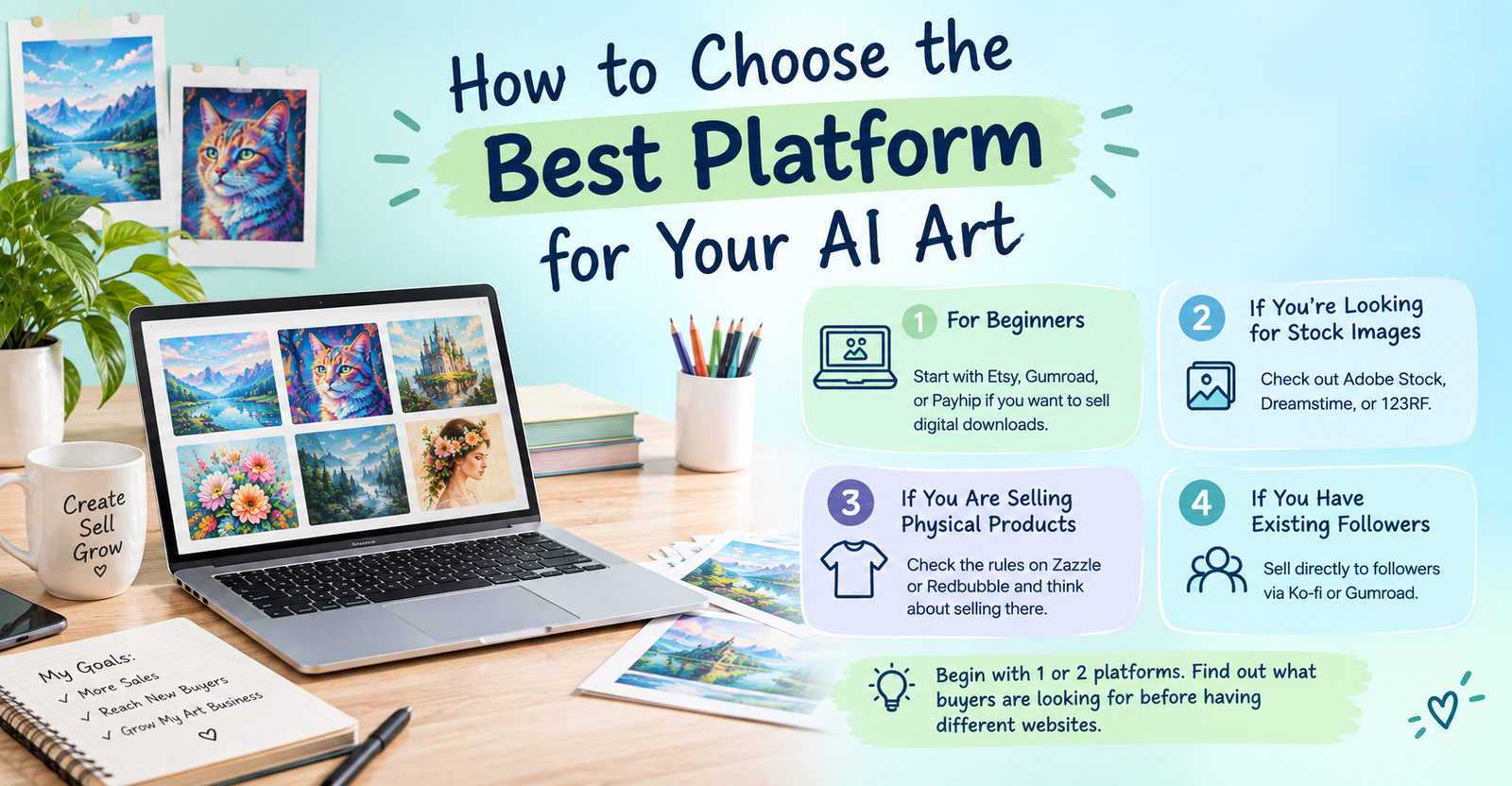
The best platforms to sell ai generated art 2026 will rely on your artwork and business goals.
Begin with 1 or 2 platforms. Find out what buyers are looking for before having different websites.
There are several ways to make money with AI art, including selling digital downloads, licensing images, providing custom designs, or selling physical products with AI-generated art. Take these practical steps.
Printable artwork, downloadable illustrations and themed art bundles are useful examples of the best digital products to sell online.
Consider looking for the same products before you select a price. Take into account the platform fees, editing time, file quality and license that you provide. You can, for instance, print a design for $5 and print a larger themed bundle for $15. These are not guaranteed market rates; they are prices at which they will start. Describe what rights the customers have, if any, for their use of the product. Don’t give exclusive rights to anything unless you can do so.
Yes, but income is variable. Some artists sell sporadically; others are more successful at developing a stronger business by working with well-concentrated collections and consistent promotion. It does not ensure results when uploading hundreds of images. The advantage of AI art passive income is that digital files can be sold over and over, without physical products being held. But you still put in time to develop, edit, list and promote your work.
When using AI tools to create art, here are the fundamental guidelines for selling AI-generated artwork:
For example, AI labels must be provided when submitting images to Adobe Stock, which also prohibits images with mentions of unlicensed third-party intellectual property.
There are various ways to make money with these best platforms to sell ai generated art 2026 such as licensing illustrations, selling printable files and creating custom products. Use a site that will accept the type of artwork you have and formulate a collection of focused pieces with an eye toward costs. If it’s quality and promoted consistently, it can be tested and a realistic online art business can be built.
Use a marketplace like Etsy or a storefront like Gumroad or Payhip. These services enable you to advertise products without needing to construct your site from the starting point.
Adobe Stock, Dreamstime and 123RF have programs for contributors to earn money from their accepted and licensed work. Other markets contribute to sales or product royalties.
Submit a good graphic design, display it on compatible products, write a good listing and set your earnings as the platform provides. Review AI content guidelines beforehand.
My aims dictate the best platforms to use to sell my AI art. Licensing works with stock sites; downloads work with print-on-demand and physical products work with print-on-demand.